


A Shower Head quote is rarely just a number on a spreadsheet. When one supplier offers $1.20 and another quotes $4.80 for a product that looks almost identical, the difference can hide major variations in resin quality, plating thickness, product weight, MOQ, testing standards, warranty risk, and even supplier type. For importers, distributors, and OEM buyers, misunderstanding that gap can lead to failed inspections, customer complaints, or overpaying for ordinary goods. This article breaks down the real cost drivers behind shower head pricing, explains when low-cost options make sense, and shows how to evaluate whether a quote reflects genuine manufacturing value or avoidable margin.
Why Shower Head Supplier Quotes Can Start at $1
Understanding this pricing delta—particularly when sourcing from East Asian manufacturing clusters—requires looking past online product listings and examining the underlying unit economics. While promotional or ultra-budget quotes can technically start at an absolute floor of $1.00, the functional baseline for a standard unit typically settles around $1.20. A supplier offering these rock-bottom prices is operating under a completely different set of assumptions regarding product lifecycle, regulatory compliance, and liability than a top-tier OEM manufacturer.
How Buyers Should Interpret Very Low Quotes
When a buyer receives a quote near the $1.00 to $1.20 threshold, it must be interpreted strictly as a baseline for the minimum viable physical construction of a product. These quotes are typically generated for highly price-sensitive developing markets, temporary housing projects, or discount promotional giveaways where long-term durability is not a primary objective.
At this price point, the supplier has stripped out all non-essential manufacturing steps and material costs. The product will likely lack internal flow regulation, utilize secondary or tertiary recycled plastics (often resulting in a finished unit weighing under 120 grams), and feature plating thicknesses falling below 0.1 microns. Buyers should view these quotes not as a bargain, but as a bare-bones physical specification that serves legitimate budget applications but will inevitably yield higher defect rates if deployed in demanding commercial or residential environments.
Common Commercial Assumptions Behind Low Prices
While the physical product is stripped down, the commercial model supporting a $1.20 shower head relies entirely on shifting risk and volume burdens to the buyer. Suppliers offering these rates typically mandate aggressive Minimum Order Quantities (MOQs), often exceeding 10,000 to 20,000 units per SKU, to achieve extreme economies of scale on injection molding machines. In contrast, premium suppliers quoting $4.80 often offer lower MOQs (e.g., 1,000 to 3,000 units) because their margins can absorb the setup costs of smaller production runs.
Furthermore, these budget quotes almost exclusively utilize EXW (Ex Works) Incoterms, leaving the buyer responsible for all inland transportation, export clearance, and loading fees. The low price also assumes zero warranty reserve; the factory builds no financial buffer into the unit cost to cover after-sales support, replacements, or liability for water damage caused by product failure, whereas premium quotes typically bake in a 2% to 3% warranty reserve.
Product Specifications That Create Major Cost Gaps
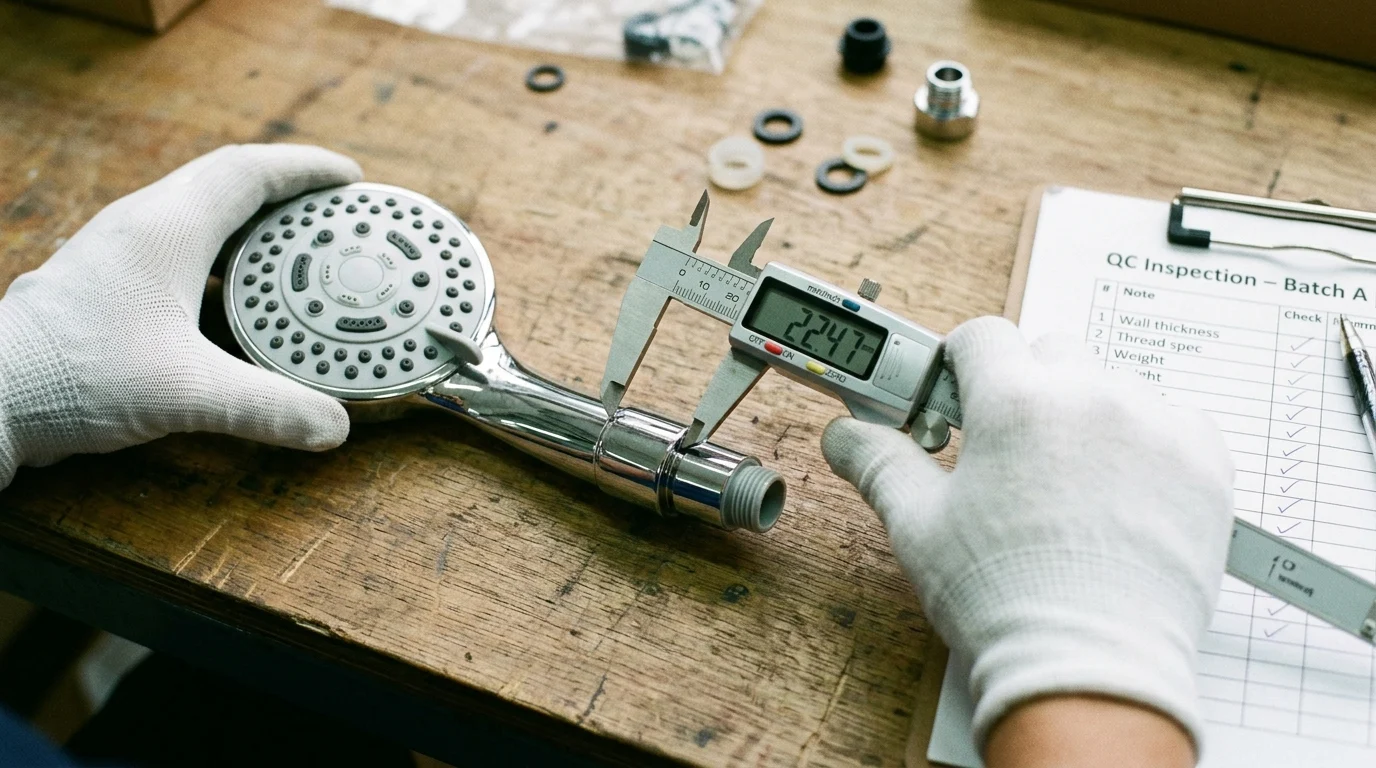
The physical bill of materials (BOM) remains the largest contributor to the price gap between entry-level and premium shower heads. Visual similarities in product photography mask profound differences in material density, component engineering, and finishing processes. The $1.20 and $4.80 quotes rarely represent the exact same SKU; rather, they reflect entirely different product grades designed to look identical on a monitor.
A comprehensive specification sheet will immediately reveal why a premium unit commands its price, as every internal and external component is upgraded to withstand daily thermal expansion, hard water scaling, and mechanical stress.
Materials, Plating Thickness, Spray Functions, and Flow Rate
The core material dictates both structural integrity and finishing quality. A budget unit relies on recycled ABS plastic, which is prone to microscopic surface pitting and structural brittleness. Conversely, a premium unit utilizes 100% virgin ABS, ensuring a flawless substrate for electroplating. Brass ball joints are substituted for plastic in premium models to prevent cracking under high water pressure. Buyers seeking a mid-tier option ($2.50–$3.50) will often find a compromise here, such as virgin ABS construction paired with standard chrome rather than expensive alternative finishes.
| Specification Area | $1.20 Baseline Quote | $4.80 Premium Quote |
|---|---|---|
| Base Material | Recycled ABS | 100% Virgin ABS |
| Ball Joint | Plastic / Nylon | Solid Brass (Lead-Free) |
| Chrome Plating | < 0.1 microns | 0.25+ microns |
| Advanced Finishes | None | PVD (Physical Vapor Deposition) |
| Flow Rate | Unregulated (varies) | Regulated (e.g., 1.8 GPM) |
| Nozzle Material | TPR / Cheap Rubber | Liquid Silicone |
Plating thickness is particularly critical. Premium units apply multiple layers of nickel before a 0.25+ micron chrome finish, whereas budget units often skip the nickel layer entirely, leading to rapid flaking and corrosion. Furthermore, electroplated chrome and PVD are distinct finishing processes with different cost structures; premium quotes often offer PVD for superior scratch resistance, a feature entirely absent in budget tiers.
Performance and Durability Tests to Compare
The true measure of a shower head's value is its performance under standardized testing. High-end suppliers bake the cost of rigorous laboratory testing into their unit prices. For example, a premium shower head is typically engineered to pass a 96-hour CASS (Copper Accelerated Acetic Acid Salt Spray) test, ensuring long-term resistance to bathroom humidity and cleaning chemicals.
Budget units rarely survive beyond a 24-hour ASS (Acetic Salt Spray) test. Additionally, premium manufacturers conduct water hammer testing, subjecting the unit to industry benchmarks—such as 100,000 cycles of pressure spikes at 0.5 MPa to 1.0 MPa—to ensure the ultrasonic welding or internal screws do not rupture under stress.
Cosmetic Versus Functional Specification Differences
Suppliers often blur the lines between cosmetic upgrades and functional necessities. A budget shower head might feature five distinct spray settings, mimicking a premium product, but utilize internal plastic diverters that wear out after a few months of rotation.
Functional specifications, such as the inclusion of certified flow regulators or check valves to prevent backflow, add significant cost but are invisible to the end user until the product is installed. Silicone nozzles represent another major divergence; cheap thermoplastic rubber (TPR) hardens and clogs with calcium deposits (typically degrading within 6 to 12 months), whereas high-grade liquid silicone allows users to easily rub away scale, extending the product's usable life by 5+ years.
How Manufacturing and Quality Systems Affect Pricing
Beyond the physical components, the operational maturity of the supplier's facility dictates a significant portion of the unit cost. Procurement teams must differentiate between the direct costs of materials and the indirect overhead of maintaining a robust Quality Management System (QMS).
The degree of process control, automation, and labor expertise deployed on the factory floor directly correlates with the reliability of the final shipment, explaining why identical BOMs can still yield different quotes from different facilities.
Factory Versus Trading Company Differences
The first layer of pricing variance often stems from the nature of the vendor. Trading companies typically add a 15% to 30% margin on top of factory costs to cover their sourcing, consolidation, and communication services. While a direct manufacturer (e.g., an integrated facility producing 500,000+ units monthly) might quote a competitive rate for a solid mid-tier unit, a trader might quote $4.80 for the same item without offering any tangible quality improvements. Buyers can distinguish a legitimately premium quote from an inflated one by auditing the supplier's QMS, verifying direct manufacturing status, and requesting a transparent BOM breakdown.
However, exceptionally low quotes almost always originate from unverified, specialized workshops rather than integrated factories. These workshops outsource injection molding, plating, and assembly to disparate local facilities, resulting in a fractured supply chain with limited traceability or unified quality control.
Tooling, Component Sourcing, and In-Process Inspection
Capital expenditure on tooling and machinery heavily influences piece-price. A factory utilizing high-precision injection molding machines will produce housings with tighter tolerances, virtually eliminating water leaks at the seams. This equipment requires higher amortization costs reflected in the unit price.
In contrast, budget suppliers use degraded molds (often costing under $4,000) that leave flash (excess plastic) on the components. This necessitates manual trimming, which introduces human error. Premium hardened steel molds ($15,000+) yield tighter tolerances but require upfront investment. While highly variable, illustrative industry estimates suggest the defect rate in cheap production environments can hover around 5% to 8%, whereas controlled, automated environments typically aim to maintain defect rates below 0.5%.
When Higher Quotes Reflect Better Quality Control
Quality control is intrinsically tied to labor costs. In a facility quoting premium rates, the assembly line includes multiple in-process inspection stations. A critical step is 100% pneumatic air-leak testing or active water testing of every single unit before packaging.
Depending on local labor rates, implementing 100% end-of-line testing adds an estimated $0.15 to $0.30 in labor and equipment overhead per unit. Suppliers quoting baseline prices utilize statistical sampling at best—testing perhaps one out of every 500 units—leaving the buyer to discover the true defect rate only after the goods have been distributed to end consumers.
How Buyers Should Compare Low and Higher Shower Head Quotes
When evaluating divergent proposals from shower head suppliers, procurement teams must look beyond the initial factory-gate invoice. A $1.20 quote often omits essential compliance and durability metrics that a $4.80 quote guarantees.
Quote Validation Steps Before Sampling
Before requesting physical prototypes, buyers must audit the supplier's Bill of Materials (BOM) and compliance documentation to ensure an apples-to-apples comparison.
- Material Specifications: Demand exact material grades. A $1.20 quote typically utilizes recycled ABS plastic and lightweight plastic ball joints. A $4.80 quote should specify virgin ABS, solid brass swivel joints, and multi-layer PVD (Physical Vapor Deposition) plating.
- Certification Verification: Cross-reference the factory's claims with regulatory databases. Check for active cUPC (Uniform Plumbing Code) registrations or EPA WaterSense listings, which require rigorous third-party auditing and are rarely included in bottom-tier pricing.
- Weight Tolerances: Request the net weight of the bare shower head. Cheaper units often feature hollowed-out internal waterways to save resin, significantly increasing the risk of pressure bursts.
Building a Landed-Cost and Risk Matrix
The Ex-Works (EXW) price is only a fraction of the final financial exposure. Experienced importers utilize a landed-cost matrix to quantify hidden liabilities associated with unverified shower head suppliers.
| Cost Variable | The $1.20 Quote (Low Tier) | The $4.80 Quote (High Tier) |
|---|---|---|
| Defect Rate | 5% to 8% (Leaks, peeling chrome) | < 1% (Tested to 500,000 cycles) |
| Warranty Claims | High risk of retail chargebacks | Negligible |
| Customs & Compliance | Risk of seizure if lacking certifications | Smooth clearance via verified docs |
| True Landed Value | High Volatility (hidden replacement costs) | Predictable Margins (stable TCO) |
When a Higher Unit Price Delivers Better Value
Opting for the $4.80 unit often yields a lower Total Cost of Ownership (TCO) for enterprise buyers, hoteliers, and plumbing distributors. Premium shower head suppliers integrate advanced flow regulators that meet strict regional mandates, such as California’s Title 20 water efficiency standards, preventing regulatory fines.
Furthermore, higher-priced suppliers typically employ automated pneumatic testing lines to check 100% of their output for micro-leaks prior to packaging. This upfront capital investment eliminates downstream warranty claims, protects brand equity, and prevents costly product recalls caused by substandard threading or toxic material leaching. Ultimately, the $4.80 unit functions as an insurance policy against supply chain disruptions and reputational damage.
Key Takeaways
- Treat a $1.00 to $1.20 shower head quote as a minimum viable specification, not a direct equivalent to mid-tier or premium products.
- Use the $2.50 to $3.50 range as a practical benchmark when balancing cost, durability, quality control, and commercial reliability.
- Verify whether low quotes require MOQs of 10,000 to 20,000 units per SKU, because the unit price may shift risk and inventory burden to the buyer.
- Do not assume a $4.80 quote means better quality; confirm material grade, plating thickness, product weight, testing, warranty, and factory status.
- Account for ABS, brass, chrome, currency, and seasonal cost fluctuations, which can move shower head price bands by roughly 10% to 15% annually.
- Request samples and compare physical specifications before ordering, especially for water-saving, filtration, high-pressure, or multi-functIon Shower Heads.
Frequently Asked Questions
Why can visually similar shower heads be quoted at $1.20 and $4.80?
The gap usually reflects differences in materials, weight, plating thickness, testing, compliance, MOQ, packaging, warranty, and supplier margin. A low quote may be a bare-bones build, while a higher quote may include better engineering—or simply inflated markup.
Is a $1.20 shower head quote always a bad choice?
Not always. It may suit promotional, temporary, or highly price-sensitive projects. However, buyers should expect simpler construction, lighter materials, thinner plating, fewer quality checks, and potentially higher defect rates in demanding residential or commercial use.
What is a reasonable target price for reliable shower head sourcing?
For many standard plastic handheld or Fixed Shower Heads, the article suggests the mid-tier $2.50 to $3.50 range often provides a better balance of durability, quality control, and commercial practicality than the cheapest or most inflated quotes.
Does a $4.80 quote guarantee premium shower head quality?
No. A higher quote may reflect better materials, lower MOQ, testing, and warranty support, but it can also include trading-company markup or quote padding. Buyers should verify specifications, samples, factory capability, and test reports.
What should buyers check before comparing shower head supplier prices?
Compare net product weight, ABS or brass grade, plating thickness, spray performance, flow regulation, packaging, MOQ, warranty terms, compliance requirements, and whether the supplier is a source factory or intermediary.