



Launching a Shower Head brand is no longer only for companies with their own factory, tooling room, and engineering team. With the right China manufacturer, entrepreneurs and distributors can build aprivate label product line using proven shower head platforms, customized finishes, packaging, spray functions, and water-saving or filtration features. The opportunity is attractive, but success depends on more than finding the lowest unit price. Buyers must understand sourcing models, landed costs, quality control, compliance, intellectual property protection, and production timelines. This guide explains how to evaluate manufacturers, define specifications, manage risks, and turn a shower head concept into a scalable branded product.
Why Choose China for Private Label Shower Heads
Establishing a private label shower head business relies heavily on leveraging mature manufacturing ecosystems. China currently dominates the global sanitary ware export market, offering unparalleled infrastructure in specialized industrial clusters such as Kaiping (Guangdong), Nan'an (Fujian), and Wenzhou (Zhejiang).
By partnering with established manufacturers in these regions, brands can bypass the extensive capital expenditures required for proprietary production facilities while maintaining strict control over product specifications, scalability, and brand identity.
Private Label vs White Label vs ODM
When navigating China's vast supplier networks, understanding the distinction between manufacturing models is critical for your supply chain strategy. Private labeling generally involves applying a custom brand identity and minor cosmetic modifications to a manufacturer's existing product architecture, allowing the buyer to build brand equity on a proven chassis. This differs from white labeling, which typically permits no structural modifications and focuses purely on applying generic packaging to stock items.
Original Design Manufacturing (ODM) represents a deeper collaboration. Here, the factory provides a catalog of pre-engineered, unbranded designs. Buyers select these designs and negotiate exclusive or semi-exclusive rights to sell them under their proprietary brand. While the factory retains the core design ownership, the buyer benefits from significantly reduced research and development timelines compared to building a product from scratch.
Key Commercial Benefits
The primary commercial advantage of sourcing from Chinese sanitary ware clusters is cost efficiency combined with rapid scalability. Tooling and injection molding costs are typically 30% to 50% lower than equivalent operations in North America or Western Europe, though it is important to note that these estimates are subject to commodity volatility and exchange rate fluctuations.
Furthermore, the proximity of component suppliers—such as producers of ceramic cartridges, silicone nozzles, and electroplating facilities—allows for highly accelerated prototyping. A standard ODM modification can often move from initial concept to a fully functional pre-production sample in just 15 to 30 days.
Main Risks to Assess Early
Despite the advantages, sourcing offshore introduces specific supply chain vulnerabilities. Intellectual property leakage remains a concern; utilizing NNN (Non-Disclosure, Non-Use, Non-Circumvention) agreements drafted under Chinese jurisdiction is a necessary safeguard. Quality fade—where a manufacturer subtly substitutes cheaper materials over successive production runs—requires stringent oversight and continuous auditing.
Additionally, financial models must account for significant trade and logistics volatility. U.S. importers must factor in current tariff regimes, such as Section 301 duties, which can drastically impact landed costs. Transpacific freight rates for a 40-foot High Cube (40HQ) container can also fluctuate between $3,000 and $8,000 depending on macroeconomic conditions and carrier capacity. Finally, predictable disruptions like the weeks-long Chinese New Year production shutdowns and Q4 peak-season logistics bottlenecks routinely delay first-time importers and must be built into annual inventory planning.
Core Product Specifications
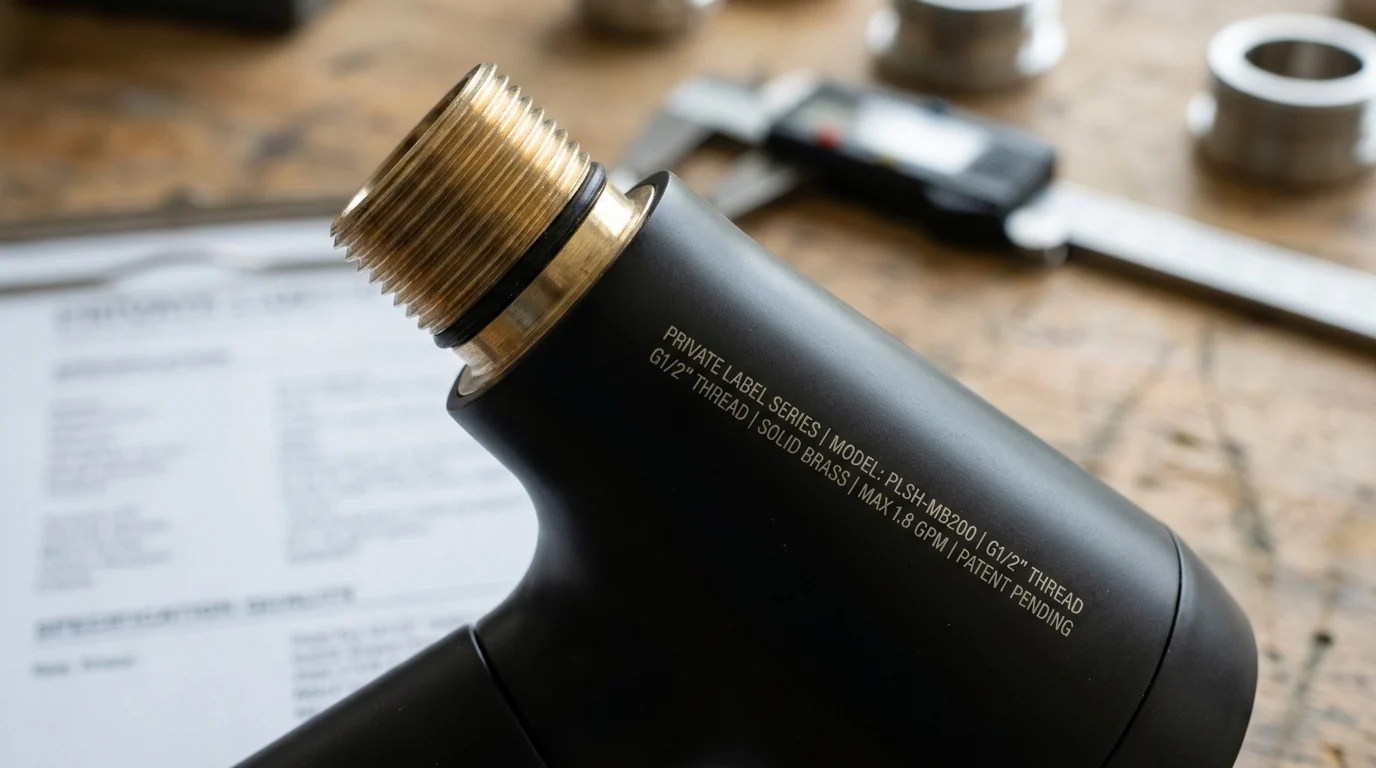
Defining precise product specifications is the foundation of quality assurance and market positioning. A private label shower head must balance aesthetic appeal with hydraulic performance and strict regulatory compliance to succeed in competitive markets.
Flow Rate, Spray Modes, and Pressure Performance
Performance metrics are dictated by flow rate and internal pressure management. To ensure compliance and optimal user experience, buyers should verify the following specification checklist:
- Federal Limits: In the United States, federal regulations mandate a maximum flow rate of 2.5 Gallons Per Minute (GPM) at 80 psi.
- Regional Standards: Stricter regional rules, such as California's energy commission regulations, restrict flow further to 1.8 GPM.
- High-Efficiency Certifications: To achieve certification under programs like EPA WaterSense, shower heads must demonstrate high-efficiency performance at 2.0 GPM or lower without sacrificing user experience.
- Internal Engineering: Meeting these metrics requires precise engineering of internal flow restrictors and optimized nozzle geometries to maintain spray velocity across various modes, such as rainfall, massage, and mist.
Materials, Finishes, and Durability
Material selection directly impacts both the unit cost and the product's operational lifespan. Acrylonitrile Butadiene Styrene (ABS) is the industry standard for lightweight, cost-effective shower heads, while solid brass and 304 stainless steel are reserved for premium, high-durability fixtures.
Surface finish durability is quantified through standardized testing. Premium electroplated finishes must typically achieve a nickel coating thickness of ≥ 8μm and a chrome layer of ≥ 0.2μm to pass a 24-hour Acetic Acid Salt Spray (ASS) test or a 96-hour Neutral Salt Spray (NSS) test without blistering or corrosion.
(Note: Relative costs in the table below are estimates and subject to raw material market volatility.)
| Material | Typical Application | Relative Cost Index | Lifespan Expectancy |
|---|---|---|---|
| ABS Plastic | Handhelds, Standard Fixed | 1.0x (Baseline) | 3 - 5 Years |
| 304 Stainless Steel | Ultra-thin Rainfall Heads | 2.5x - 3.5x | 7 - 10 Years |
| Solid Brass | Premium Fixtures, Valves | 4.0x - 6.0x | 10+ Years |
Compliance and Certification Requirements
Market entry is contingent upon securing the appropriate regional certifications. North American markets strictly require cUPC (Uniform Plumbing Code) certification, which involves rigorous testing of burst pressure, temperature resistance, and mechanical strength. In the European Union, products must comply with the CE mark and EN 1112 standards for sanitary tapware. For the Australian market, the WaterMark certification scheme is legally mandatory.
Procuring private label products from a factory that already holds these certifications for their ODM molds can save a brand upwards of $5,000 to $10,000 in testing fees and months of administrative delays. However, buyers must clarify that factory-held certifications do not automatically transfer to a private-label brand. You must confirm whether the factory is the certificate holder allowing white-label use, or if a separate brand-specific listing and administrative fee are required to legally display the certification marks.
Supplier Sourcing and Qualification
Identifying a capable manufacturing partner requires moving beyond superficial directory listings to evaluate technical capabilities, quality control infrastructure, and business alignment.
Factory Screening Criteria
Effective factory screening demands a rigorous audit of the supplier's operational parameters. Key criteria include possessing a valid ISO 9001:2015 quality management system and demonstrating sufficient production capacity, typically evaluated at a baseline of 100,000 units per month for established mid-tier factories.
A critical differentiator is the presence of an in-house testing laboratory. Factories equipped to perform their own thermal cycling, salt spray, and hydrostatic burst pressure tests (often pushed up to 300 psi) demonstrate a higher commitment to quality assurance than those entirely reliant on third-party labs.
Trading Company vs Manufacturer
Buyers must deliberately choose between partnering with a trading company or a direct manufacturer. Trading companies generally offer lower Minimum Order Quantities (MOQs)—often between 100 and 300 pieces—and can consolidate diverse product lines into a single shipment. However, they typically apply a 10% to 20% markup on the baseline unit cost.
Direct manufacturers provide the lowest possible unit costs and direct control over engineering modifications. The trade-off is higher MOQs, usually starting at 500 to 1,000 units per SKU, and a narrower product focus restricted to their specific in-house production capabilities.
RFQ Preparation and Sample Evaluation
A comprehensive Request for Quotation (RFQ) minimizes ambiguity and sets a professional tone. The RFQ must explicitly detail thread standards (e.g., G1/2 or NPT standard connections), desired flow rates, material compositions, and required plating thicknesses.
Upon receiving quotations, the sample evaluation phase begins. Buyers should request both a 'golden sample' (the idealized production standard) and a breakdown of the Bill of Materials (BOM). Samples must be physically installed and subjected to local water pressure conditions to verify flow consistency, operating sound, and joint integrity before mass production is authorized.
Cost, MOQ, Packaging, and Logistics
Establishing a profitable private label enterprise requires a granular understanding of unit economics, supply chain logistics, and the capital requirements dictated by supplier terms.
Key Cost Drivers
The baseline cost of a shower head is primarily dictated by raw material spot prices and the complexity of the internal cartridge. However, surface treatment serves as a major variable cost driver.
Standard electroplated chrome is the most economical finish. Upgrading to matte black via electrocoating or specialized finishes like brushed nickel and brushed gold via Physical Vapor Deposition (PVD) can add between $1.50 and $3.00 per unit. Furthermore, integrating advanced features like thermostatic temperature control or LED lighting modules will significantly elevate the base BOM cost.
(Note: All cost estimates below are subject to commodity price volatility, tariff changes, and factory capacity, and should not be mistaken for fixed industry benchmarks.)
| Cost Component | ABS Chrome Shower Head | Brass PVD Shower Head |
|---|---|---|
| Raw Materials & Injection/Casting | $1.20 - $2.50 | $8.00 - $14.00 |
| Surface Treatment (Plating/PVD) | $0.50 - $0.80 | $2.50 - $4.00 |
| Assembly & QC | $0.30 - $0.50 | $0.80 - $1.20 |
| Packaging (Custom Color Box) | $0.40 - $0.70 | $0.80 - $1.50 |
| Total Estimated FOB Cost | $2.40 - $4.50 | $12.10 - $20.70 |
MOQ, Lead Time, Payment Terms, and Incoterms
Standard MOQs for private label shower heads typically range from 500 to 1,000 units per finish, driven largely by the minimum batch sizes required for electroplating vats. Standard production lead times average 35 to 45 days post-deposit, though this extends significantly around major holidays like Chinese New Year.
Payment terms almost universally follow a 30/70 structure: a 30% Telegraphic Transfer (TT) deposit initiates production, with the remaining 70% balance due upon completion and successful inspection, prior to shipment. Incoterms should be negotiated as Free On Board (FOB) for full container loads to ensure the supplier handles local export customs, whereas Ex Works (EXW) may be more appropriate for smaller, consolidated shipments.
Packaging, Branding, and Retail Readiness
Retail readiness requires packaging that protects the product during transit while effectively communicating brand value. E-commerce brands must ensure packaging passes ISTA 1A drop-test standards to minimize return rates caused by transit damage.
Transitioning from a factory's generic white box to a custom-branded corrugated color box with high-density EVA foam inserts typically incurs an additional $0.30 to $0.80 per unit, depending on print complexity and volume. Including localized installation manuals and thread seal tape (Teflon tape) further enhances the out-of-box experience and reduces customer service inquiries.
Launch Decision Framework
The transition from sourcing to market launch requires a disciplined framework to validate financial projections and mitigate final execution risks.
Margin Potential and Market Fit
Sustainable profitability in the plumbing fixtures category requires robust gross margins to absorb customer acquisition, platform fees, and fulfillment costs. However, margin requirements and pricing power vary dramatically by fulfillment and acquisition model:
- Direct-to-Consumer (DTC) E-commerce: Often requires 70% to 80% gross margins to absorb high digital advertising and customer acquisition costs.
- Amazon FBA: Sellers typically target 60% to 70% gross margins to comfortably cover platform referral fees, FBA fulfillment costs, and PPC advertising.
- Wholesale/B2B: Traditional wholesale models can operate on 40% to 50% margins due to larger volume orders and lower per-unit acquisition costs.
For example, an ABS multi-functIon Shower Head might have an FOB cost of $3.50. Once you itemize additional per-unit expenses—such as $1.50 for ocean freight, $2.50 for Section 301 import duties and standard tariffs, and $0.50 for insurance and domestic drayage—the final landed cost reaches $8.00. This product should then be positioned for a retail price between $24.00 and $29.00 to hit standard e-commerce margins. Market fit must be validated by analyzing competitor pricing density and identifying gaps in specific niches, such as high-pressure solutions for low-flow households or integratedwater-filtration models.
When to Choose Standard ODM Products
The decision to utilize standard ODM products versus investing in custom tooling hinges on capital availability and time-to-market priorities. Standard ODM modifications allow a brand to launch within 60 days with minimal upfront engineering costs.
Conversely, developing a completely proprietary design requires commissioning custom injection molds, which can cost between $3,000 and $8,000 per cavity for plastic components, and extends the development timeline to 120 days or more.
Key Takeaways
- Choose private label, white label, or ODM based on how much customization, exclusivity, and product control your shower head brand needs.
- Work with established Chinese sanitary ware clusters to benefit from mature supply chains, faster prototyping, and scalable production capacity.
- Define flow rate, spray modes, materials, finishes, filtration features, packaging, and compliance requirements before sampling to reduce quality risks.
- Plan for realistic landed costs by including tariffs, inspection fees, freight volatility, customs expenses, and seasonal production delays.
- Protect your brand with China-specific NNN agreements, trademark planning, clear mold ownership terms, and ongoing supplier audits.
- Build your launch timeline around sample development of about 15 to 30 days for standard ODM modifications, plus inspection and shipping lead times.
Frequently Asked Questions
What is the difference between private label, white label, and ODM shower heads?
Private label allows branding plus minor product or packaging changes. White label usually means selling a stock item with your logo. ODM offers deeper collaboration using a factory’s pre-engineered designs, often with more customization and possible market exclusivity.
Why source private label shower heads from China?
China has mature sanitary ware clusters, established component suppliers, and scalable production capacity. Buyers can reduce tooling and molding costs, shorten sampling timelines, and work with factories experienced in global shower head, Hand Shower, and bathroom hardware exports.
How long does it take to develop a shower head sample?
For standard ODM modifications, a functional pre-production sample can often be completed in about 15 to 30 days, depending on changes to materials, spray modes, finish, packaging, and testing requirements.
What specifications should I confirm before ordering?
Confirm flow rate, spray modes, pressure performance, materials, finish, nozzle type, filtration options, packaging, compliance requirements, and quality inspection standards. Clear specifications help prevent quality fade and protect your brand positioning.
How can I protect my shower head design and brand?
Use NNN agreements drafted for Chinese jurisdiction, register trademarks early, define ownership of molds and packaging artwork, and limit sensitive design files to approved suppliers. Regular audits and clear contracts reduce IP and supply chain risks.
