



Choosing a factory for a Shower Head line is not just a sourcing decision—it is a brand-risk decision. A small tolerance issue, weak plating process, or missing compliance document can quickly become leaks, recalls, returns, and lost distributor confidence. For brands developingOEM shower products, the right partner must combine engineering discipline, material knowledge, quality control, and export experience. This guide explains how to evaluate manufacturer capabilities, define product specifications, reduce IP and compliance risks, and select a factory that can support long-term growth. It also highlights practical considerations for modern bathroom categories, from water-saving spray modes to filtration-focused and wellness-oriented shower solutions.
Why the Right OEM Shower Head Manufacturer Matters
Partnering with a specialized OEM shower head manufacturer requires a strategic alignment between brand positioning and factory capabilities. The sanitary ware market demands high precision; a deviation in manufacturing tolerances can result in catastrophic leaks, premature finish degradation, or non-compliance with regional water regulations.
It is also critical to distinguish early on between OEM (Original Equipment Manufacturer) production—where products are custom-built to your exact engineering specifications—and ODM (Original Design Manufacturer) or private-labeling, where a brand simply applies its logo to an existing factory design. This guide focuses on navigating OEM sourcing.
For plumbing brands, the cost of poor quality extends far beyond the factory gate. Even a marginal defect rate increase—such as an illustrative 1.5%—can severely erode profit margins once reverse logistics, warranty claims, and reputational damage are factored in. Securing a manufacturer with mature quality management systems is foundational to scaling a successful hardware brand.
How to Define Your OEM Manufacturing Needs
Defining OEM manufacturing needs begins with specifying the target market tier and operational environment, rather than just browsing a supplier's existing catalog. Premium commercial applications typically necessitate solid brass bodies. While standard forging brass like CuZn40Pb2 (CW617N) is common, aggressive water chemistry and high-usage environments require dezincification-resistant (DZR) alloys, such as CW602N, to prevent structural degradation over time. Furthermore, stringent North American regulations necessitate lead-free brass (e.g., CW511L, compliant with NSF 61/AB1953) or stainless steel (304/316) options for premium positioning and legal compliance.
Conversely, the mid-market residential segment often leverages ABS (Acrylonitrile Butadiene Styrene) plastics for cost efficiency and lightweight ergonomics. Procurement teams must establish baseline requirements for base materials, expected lifecycle, and the target retail price point before initiating supplier outreach. This includes mapping out user demographics and regional water pressure constraints to ensure the factory's engineering capabilities align with your brand's specific vision.
Key Risks of Choosing the Wrong Supplier
Selecting an ill-equipped manufacturing partner exposes a brand to significant operational and legal liabilities. One primary risk is intellectual property (IP) leakage, where proprietary nozzle geometries or housing designs are repurposed for white-label competitors. Additionally, buyers must be wary of manufacturers that produce their own house brands, as they may eventually compete directly against your products using the manufacturing insights gained from your partnership.
Factories lacking robust metallurgical controls may struggle with consistent plating thickness. A failure to maintain strict electroplating parameters often results in products failing standard 24-hour acid salt spray (ASS) tests, leading to blistering and corrosion within the first year of consumer use. Beyond physical defects, partnering with a supplier that lacks proper compliance documentation or supply chain resilience can result in costly customs seizures, forced product recalls, or severe launch delays. Other critical risks include undisclosed subcontracting, which frequently leads to quality fade, and social compliance failures that can severely damage a brand's public image.
Product Specifications to Validate
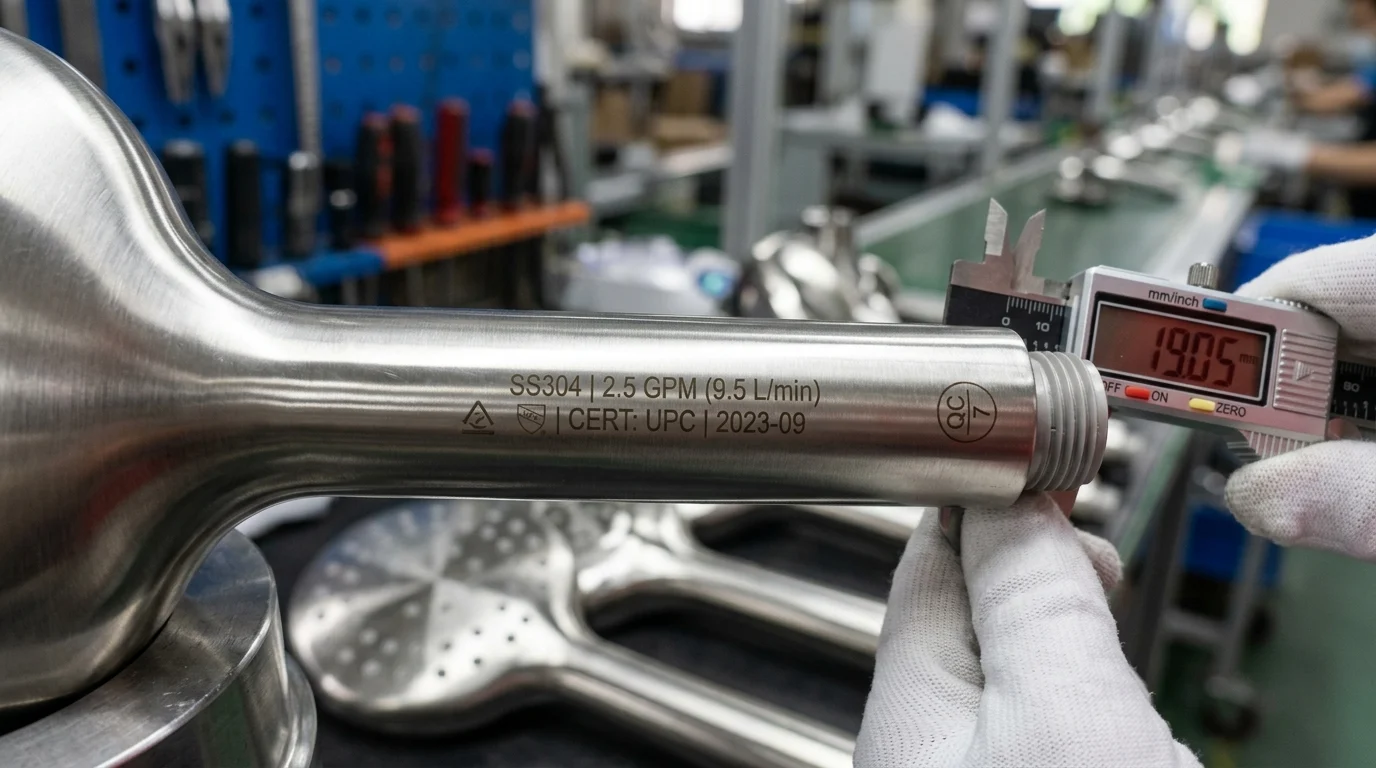
Translating conceptual designs into mass-produced fixtures requires rigorous specification management. Every interface, from standard European G1/2" connections to North American NPT (National Pipe Thread) standards, must be explicitly documented to match the target market's plumbing codes and prevent misinterpretation on the factory floor.
Materials, Finishes, Cartridges, and Nozzles
The selection of materials and surface treatments dictates both the aesthetic longevity and the manufacturing complexity of the shower head. Key components to specify include:
- Outer Finishes: The exterior requires careful specification between electroplating, Physical Vapor Deposition (PVD), and electrophoretic coatings.
- Nozzles: Liquid silicone rubber (LSR) nozzles are the industry standard for ensuring anti-limescale properties.
- Internal Components: Flow restrictors and diverter cartridges must be specified by brand or performance grade. Utilizing ceramic disc cartridges rated for 500,000 cycles ensures the mechanical reliability of handheld diverter mechanisms.
| Finish Technology | Typical Thickness | Salt Spray Resistance (ASS) | Cost Premium |
|---|---|---|---|
| Electroplated Chrome | Nickel: 10-15µm, Chrome: 0.2-0.3µm | 24 Hours | Baseline |
| PVD (Physical Vapor Deposition) | 0.3-0.5µm | 48+ Hours | +15-25% |
| Matte Black (Electrophoresis) | 15-20µm | 24 Hours | +5-10% |
Performance Standards for Handheld and Fixed Shower Heads
Performance standards vary heavily based on the end-market and the specific product type:
- Handheld Shower Heads (U.S. Market): Compliance with the EPA WaterSense program requires shower heads to deliver a maximum flow rate of 2.0 Gallons Per Minute (GPM) while maintaining a minimum of 1.5 GPM at 45 psi to ensure adequate spray force.
- Fixed Rain Shower Heads: These often feature larger internal volumes, requiring specialized air-injection technology to maintain spray velocity at lower flow rates. Specifications must detail the required pressure drop, spray coverage angle, and acoustic limits (e.g., complying with EN 1112 acoustic classifications at 3 bar pressure).
How to Document Technical Requirements
Technical requirements must be centralized within a comprehensive Bill of Materials (BOM) and technical drawing package. To make these dense engineering requirements actionable, procurement teams should utilize a tiered specification checklist:
- Basic Specifications: 2D and 3D CAD files dictating critical dimensions with strict tolerances (typically ±0.1mm for threaded connections), base material grades, and regional thread standards (G1/2" vs. NPT).
- Premium Specifications: Boundary samples for cosmetic finishes (defining acceptable limits for micro-scratching under D65 daylight inspection lamps), cycle-testing requirements, and acoustic limits.
Providing this structured documentation ensures that both engineers and non-technical procurement staff are aligned on the deliverables.
Quality, Testing, and Compliance Checks
A rigorous quality assurance framework separates top-tier OEM manufacturers from high-risk assemblers. Unlike an ODM arrangement where a buyer might accept the factory's baseline quality, OEM production requires you to engineer quality into the manufacturing process. Industry-standard Acceptable Quality Limit (AQL) levels for Premium Shower Heads are typically set at 0 for critical defects, 1.5 for major defects, and 4.0 for minor defects.
Certifications and Lab Testing Capabilities
Market entry depends on regulatory compliance. A qualified OEM must have the capability to produce goods that meet or exceed standards such as cUPC (ASME A112.18.1/CSA B125.1) for North America, WRAS for the UK, and ACS for France.
Evaluating a manufacturer's internal lab capabilities is crucial. Factories equipped with in-house spectrometers for raw material analysis and automated test rigs for flow rate verification can identify compliance failures weeks before third-party certification bodies are involved.
Inspection Checkpoints and Quality Metrics
Standardized inspection checkpoints must be established at the raw material, in-process, and final assembly stages. Key metrics include plating adhesion tests (cross-cut tape tests) and dimensional verification of o-ring grooves.
| Testing Category | Standard Metric | Acceptable Threshold |
|---|---|---|
| Burst Pressure | Static Hydrostatic Test | 500 psi (3.45 MPa) for 1 minute |
| Thermal Cycling | Alternating Hot (80°C) / Cold (10°C) | 10,000 continuous cycles (per ASME standards) without leakage |
| Flow Rate (WaterSense) | Dynamic Pressure at 45 psi | ≤ 2.0 GPM maximum, ≥ 1.5 GPM minimum |
Implementing these standardized tests ensures that the product will safely withstand pressure spikes in municipal water systems without housing fractures or seal blowouts.
How to Verify Manufacturing Consistency
Manufacturing consistency is best verified through process capability indices. A supplier should demonstrate a Process Capability Index (Cpk) of greater than 1.33 for critical-to-quality dimensions, indicating that the production process is highly stable and tightly centered within specification limits.
While documentation and third-party ISO 9001:2015 audits are essential, they cannot replace physical on-site floor audits. Physically verifying in-house plating lines, forging shops, and assembly floors ensures the factory isn't secretly subcontracting critical steps, guaranteeing that isolated defects do not evolve into systemic batch failures.
Cost, Sourcing, and Supply Chain Evaluation
Evaluating the commercial viability of an OEM partnership requires analyzing the Total Cost of Ownership (TCO). Unit price is only a fraction of the financial equation; tooling amortization, logistics, and supply chain resilience dictate the long-term profitability of a product line.
Tooling Costs, MOQ, and Lead Times
Custom shower head designs require upfront capital for tooling. Plastic injection molds for ABS components typically range from $3,000 to $8,000 (utilizing plastic mold steels like NAK80 or S136). In contrast, complex brass forging dies require durable hot-work tool steels like H13 to withstand extreme temperatures and pressures, costing between $1,500 and $4,000 depending on cavity count. It is important to note that these figures can vary by an order of magnitude depending on the country of manufacture, part geometry complexity, and the required mold lifespan.
Crucially, procurement contracts must include explicit mold and tooling ownership clauses. These foundational legal safeguards ensure that once the tooling is fully paid for, it remains the exclusive property of your brand, preventing the factory from holding molds hostage or using them to produce components for competitors.
Minimum Order Quantities (MOQs) generally hover between 500 and 2,000 units per finish. Lead times must be factored into the launch schedule; expect 30 to 45 days for tooling development and first article inspection (FAI), followed by 35 to 60 days for mass production.
Packaging, Labeling, and Documentation
While ODM suppliers often rely on standard, off-the-shelf white boxes, OEM partnerships require packaging engineered to protect your specific, custom finishes during trans-oceanic shipping. Specifications should mandate compliance with ISTA 1A drop test standards to minimize transit damage. The OEM must also demonstrate competency in applying compliant labeling, including scannable UPC barcodes and regional regulatory marks.
Documentation requirements extend beyond user manuals to include detailed packing lists, commercial invoices, and certificates of origin, all of which are essential for seamless customs clearance and minimizing demurrage charges at the port.
Supply Continuity and Spare Parts Availability
A robust supply chain strategy accounts for post-sale support. Brands should negotiate the inclusion of a 3-5% buffer of spare parts—such as replacement silicone nozzles, flow restrictors, and EPDM washers—within each mass production run.
Securing a commitment for spare parts availability for a minimum of 3 to 5 years post-production protects the brand against localized warranty claims and prevents the need to replace entire shower units due to a single failed sub-component.
How to Qualify and Select the Best Supplier
The final qualification of an OEM shower head manufacturer is a multifaceted process that balances technical capability with commercial reliability. Establishing a structured evaluation framework prevents emotional or purely price-driven decision-making, ensuring a sustainable B2B partnership.
Supplier Shortlisting Steps
The shortlisting process should begin with concrete due-diligence steps to filter out trading companies masquerading as direct manufacturers. Essential actions include:
- Verifying Business Licenses: Ensure the registered business scope explicitly includes manufacturing, not just trading.
- Checking Export Customs Records: Review bill of lading data to confirm if the supplier has a verifiable history of shipping to your target market.
- Requesting Video Factory Tours: If an in-person visit is impossible, a live video walkthrough of the production floor can quickly validate their operational scale and equipment.
Assessing vertical integration is more indicative of capability than arbitrary factory size metrics. A facility with in-house forging, plating, and testing typically offers better quality control and IP protection than a larger but fragmented network of sub-contractors. Establish clear project management communication protocols during this phase to gauge their responsiveness.
OEM Manufacturer Scorecard Criteria
Implementing a standardized scorecard allows procurement teams to objectively rank potential suppliers. A highly effective weighting model allocates 40% to technical and engineering capacity, 30% to quality management systems, 20% to commercial terms (pricing and payment structures), and 10% to communication and project management responsiveness.
Financial stability is a critical yet often overlooked metric within the scorecard. Partnering with a manufacturer demonstrating a solid annual turnover—often used as a general benchmark around $5 million for mid-to-large scale buyers, though this should be verified via official financial audits and contextualized to your specific region—reduces the risk of the factory declaring bankruptcy mid-production or cutting corners on raw materials to manage cash flow.
Agreement Terms That Protect Your Brand
The culmination of the selection process is a watertight manufacturing agreement. An internationally enforceable NNN (Non-Disclosure, Non-Use, Non-Circumvention) agreement is mandatory prior to sharing CAD files.
The final contract must
Key Takeaways
- Start supplier discussions with a clear specification sheet covering materials, spray functions, pressure range, finish, packaging, compliance, and target retail price.
- Choose OEM manufacturing when your brand needs custom engineering, because ODM and private-label models usually rely on existing factory designs.
- Match materials to the application, using brass, lead-free brass, stainless steel, or DZR alloys for premium or regulated markets and ABS for cost-efficient residential products.
- Audit the manufacturer’s quality controls for tolerances, plating thickness, pressure testing, and salt spray performance to reduce leaks, corrosion, and warranty claims.
- Protect your brand by evaluating IP safeguards, subcontracting risks, compliance documentation, and whether the factory’s own products could compete with yours.
- Prioritize experienced source factories with full-chain production, R&D capability, and global export experience when scaling shower head lines across multiple markets.
Frequently Asked Questions
What should I confirm before contacting an OEM shower head manufacturer?
Define your target market, material requirements, water pressure range, spray functions, compliance needs, finish standards, packaging, and target cost. Clear specifications help the factory evaluate feasibility and quote accurately.
How is OEM shower head manufacturing different from ODM or private labeling?
OEM manufacturing builds products to your engineering specifications, while ODM or private labeling uses an existing factory design with limited customization. OEM is better for brands needing unique performance, appearance, or compliance requirements.
Which materials are commonly used for OEM shower heads?
Premium products may use brass, lead-free brass, stainless steel, or DZR alloys for durability and compliance. Mid-market residential models often use ABS for lightweight handling, cost efficiency, and flexible design options.
Why is quality control important when choosing a shower head supplier?
Poor quality can cause leaks, finish failure, warranty claims, returns, and brand damage. A reliable supplier should control tolerances, plating thickness, pressure performance, and inspection processes before mass shipment.
Can Xinyi Sanitary support custom shower head projects?
Yes. Xinyi Sanitary is a source factory established in 2005, offering one-stop OEM, ODM, and OBM services for hand showers, rainfall shower heads, Shower Sets, filters, sliding bars, and bathroom accessories.
