



The right Shower Head manufacturing partner can determine whether a product line grows profitably or becomes weighed down by returns, inconsistent quality, and supply delays. For brands, distributors, and project buyers, the decision is no longer just about comparing unit prices; it requires evaluating materials, tooling, testing systems, customization capacity, and long-term service reliability. A manufacturer with proven OEM/ODM experience, water-efficient design knowledge, and stable global distribution can support better product performance from concept to repeat orders. This guide explains how to assess technical capability, quality control, product range, and partnership fit so you can choose a supplier built for sustainable growth.
Why Manufacturer Selection Matters
Selecting a shower head manufacturerr](https://www.xinyisanitary.com/about-us/) extends far beyond securing the lowest unit price; it dictates product lifecycle stability, brand reputation, and supply chain resilience. As the global plumbing fixtures market matures, brands must evaluate manufacturing partners through a strategic lens, prioritizing long-term alignment over transactional procurement.
Define the Manufacturer’s Role
A competent shower head manufacturer functions as an extension of a brand's operational infrastructure. In Original Equipment Manufacturer (OEM) arrangements, the facility must execute exact specifications with zero deviation, making robust intellectual property (IP) protection and clear communication protocols essential. For Original Design Manufacturer (ODM) scenarios, the partner takes on a hybrid role, combining hydrodynamic engineering with industrial design. A successful partnership relies on the manufacturer's ability to manage upstream raw material sourcing, maintain scalable assembly lines, and provide continuous value engineering to optimize flow rates and material yields.
Avoid Price-First Sourcing Risks
Procurement strategies heavily weighted toward rock-bottom pricing frequently encounter hidden operational costs. Sourcing shower heads based solely on initial quote disparities often results in substandard material substitution, such as utilizing recycled ABS plastics instead of virgin resins, or opting for lightweight zinc alloys over low-lead brass. While inferior materials may reduce upfront unit costs, they reliably drive up field defect rates. This elevated failure rate ultimately erodes net profit margins when factoring in warranty claims, reverse logistics, and brand damage. Furthermore, relying on a single low-cost supplier exposes brands to supply chain shocks; factoring in geopolitical diversification and regional stability is a critical safeguard against long-term disruption.
Technical Capabilities to Evaluate
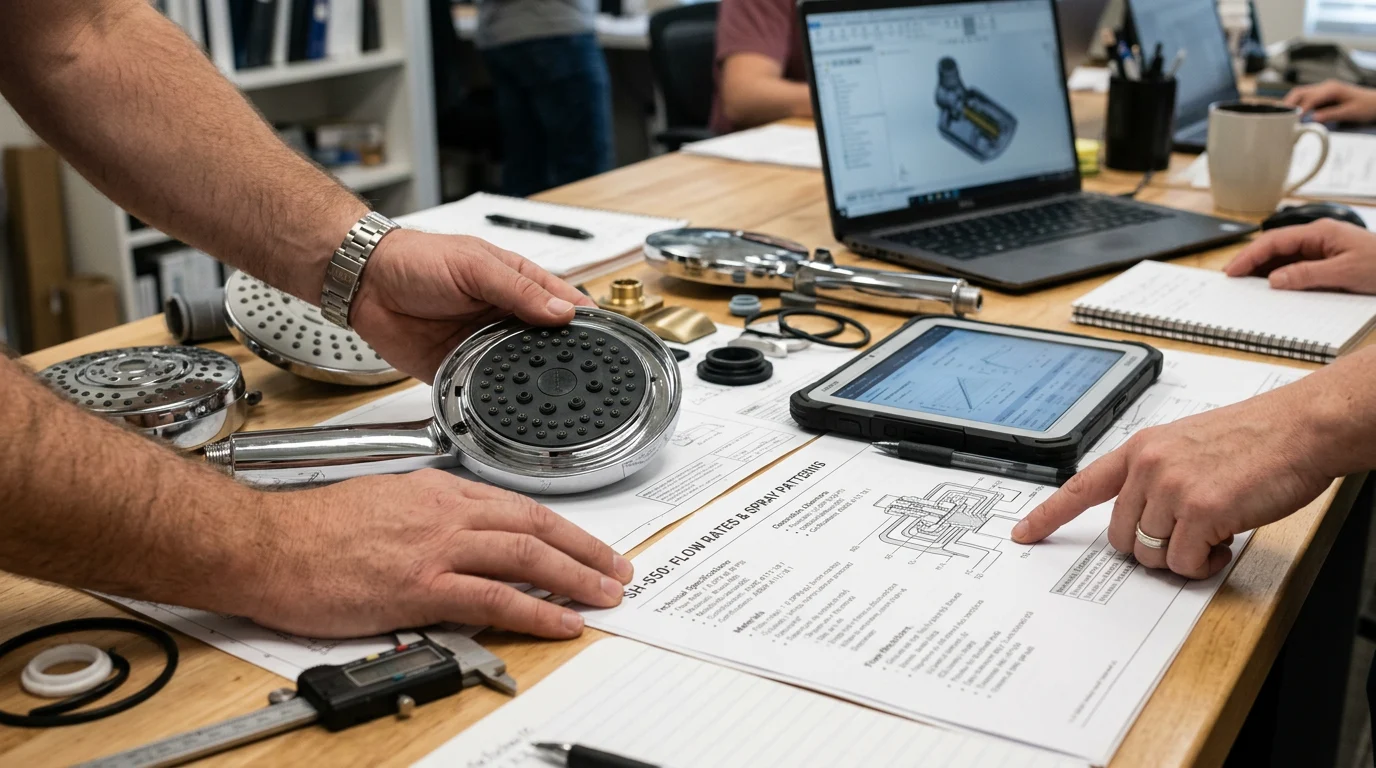
Evaluating a manufacturer's technical infrastructure requires a granular analysis of their engineering capabilities, R&D resources, and prototyping equipment. A premier shower head manufacturer must demonstrate proficiency in precision engineering, metallurgy, and polymer science to design and validate fixtures that withstand continuous hydrothermal stress.
Assess Materials and Surface Finishing
Material integrity and surface treatment are critical determinants of a shower head's longevity. Premium manufacturers utilize virgin ABS for shower heads to ensure high impact resistance and thermal stability, while solid components demand low-lead brass (e.g., CW617N) or 304/316 stainless steel. Surface finishing requires rigorous electroplating or Physical Vapor Deposition (PVD) processes. High-tier suppliers routinely subject their chrome finishes to 24-hour to 48-hour Copper Accelerated Acetic Acid-Salt Spray (CASS) testing during the validation phase to guarantee corrosion resistance against hard water and high humidity.
| Material | Primary Application | Key Technical Specification | Typical Lifespan (Years) |
|---|---|---|---|
| Virgin ABS | Handheld & Fixed Shower Heads | High thermal resistance, lightweight | 5 - 7 |
| Low-Lead Brass | Valves, Connectors, Premium Heads | Tensile strength > 350 MPa, Pb < 0.25% | 15 - 20+ |
| 304 Stainless Steel | Ultra-thin Rain Shower Heads | Excellent corrosion resistance, unplated | 10 - 15 |
Review Tooling, Prototyping, and Customization
The capacity for rapid prototyping and precision tooling separates standard assemblers from advanced manufacturing partners. Evaluating the facility's CNC machining centers and injection molding capabilities is essential. Tooling precision must be tight enough to prevent micro-leaks at joint seams, requiring tolerances appropriate for high-grade sanitary ware rather than standard consumer plastics. Prospective partners should offer streamlined prototyping cycles, utilizing 3D printing or SLA techniques within 5 to 7 days, while full steel tooling for custom injection molds should ideally be completed within a 30- to 45-day lead time.
Verify Product Testing Data
A robust technical partner must maintain an in-house laboratory equipped to validate hydrodynamic performance and structural durability during the engineering phase. Critical testing protocols include hydrostatic pressure testing (often standardized at 0.5 to 1.0 MPa), flow rate calibration to meet strict regional water conservation mandates (such as 1.8 to 2.5 Gallons Per Minute), and thermal shock resistance. Mechanical components like diverters and swivel ball joints must also undergo lifecycle testing, typically mandated to survive 10,000 to 50,000 actuation cycles without failure before mass production begins.
Quality Systems and Compliance
While technical capabilities validate the design, consistent product reliability is anchored in stringent quality management systems and adherence to international regulatory standards on the production line. A manufacturer's ability to maintain defect-free mass production is directly proportional to the maturity of their internal quality control frameworks.
Use Factory Audit Criteria
Conducting a comprehensive factory audit is an indispensable step in supplier vetting. Audits should verify the implementation of ISO 9001:2015 standards, assessing document control, continuous improvement protocols, and workforce training. Auditors must examine the shop floor for lean manufacturing principles, such as the 5S methodology, which indicates operational discipline. Evaluating the calibration frequency of measurement instruments and the traceability of raw material batches ensures the manufacturer maintains strict control over production variables.
Check Certifications and Regional Requirements
Shower head components are heavily regulated due to their interaction with potable water systems and environmental conservation goals. A qualified manufacturer must demonstrate experience in securing and maintaining regional certifications. For the North American market, compliance with cUPC (Uniform Plumbing Code) and EPA WaterSense (requiring a maximum flow rate of 1.8 or 2.0 GPM) is mandatory. European markets require WRAS (UK), ACS (France), or KTW (Germany) approvals to certify that non-metallic components do not leach toxins or alter water chemistry. Partnering with a manufacturer that already possesses these certifications significantly accelerates time-to-market.
Compare Quality Control Processes
The architecture of a manufacturer's quality control process dictates the final output quality. Best-in-class facilities implement a multi-tiered inspection protocol comprising Incoming Quality Control (IQC), In-Process Quality Control (IPQC), and Final Quality Control (FQC). Buyers must establish clear Acceptable Quality Limit (AQL) standards with the manufacturer prior to production. A standard industry benchmark for premium sanitary ware dictates an AQL of 1.5 for major defects (e.g., plating peeling, leaks) and 4.0 for minor defects (e.g., microscopic surface scratches). Facilities utilizing automated optical inspection (AOI) alongside manual pressure testing offer the highest assurance of defect mitigation.
Commercial and Logistics Factors
Beyond engineering and quality, the commercial viability of a manufacturing partnership hinges on financial terms, supply chain agility, and post-production support. Structuring favorable commercial agreements ensures procurement remains cost-effective without compromising product integrity.
Compare Quotations and MOQs
Analyzing quotations requires looking past the bottom-line unit cost to understand the total cost of ownership. Buyers must itemize tooling costs, material surcharges, and assembly fees. Minimum Order Quantities (MOQs) act as a critical commercial lever; standard MOQs for custom OEM shower heads typically range from 500 to 1,000 pieces per SKU. Because rigid MOQs can strain cash flow for new product introductions, buyers should negotiate tiered pricing structures and tooling cost amortization. For example, a manufacturer might rebate the mold cost after a cumulative volume of 10,000 units, providing a balanced risk-sharing model.
| Commercial Factor | Standard Industry Benchmark | Premium / Flexible Partner Benchmark |
|---|---|---|
| Standard MOQ | 1,000 - 2,000 units per SKU | 300 - 500 units per SKU |
| Payment Terms | 30% Deposit / 70% Before Shipment | 30% Deposit / 70% Net 30/60 Days |
| Tooling Amortization | Paid 100% upfront by buyer | 50% upfront, 50% rebated after 10k units |
Review Packaging, Warehousing, and Export Support
Efficient logistics and robust packaging are paramount for international sanitary ware distribution. Manufacturers must provide packaging that complies with international transit standards, such as the ISTA 1A drop test, to prevent surface abrasions or structural damage during shipping. The supplier's proximity to major export hubs and their proficiency in managing Incoterms (commonly FOB or FCA) dictate freight efficiency. Manufacturers offering temporary warehousing capabilities or mixed-container consolidation add significant logistical value for buyers managing complex inventory cycles.
Evaluate Warranty and After-Sales Service
A manufacturer's commitment to their product is reflected in their warranty and after-sales provisions. Standard industry agreements should mandate a minimum 3- to 5-year warranty on electroplated finishes and structural integrity. Crucially, the contract must define the resolution process for batch defects. Top-tier manufacturers agree to Root Cause and Corrective Action (RCCA) reporting within 72 hours of defect notification and accept financial liability for replacement units and expedited air freight if the fault originates in the manufacturing process.
Supplier Selection Process
Transitioning from supplier evaluation to final selection requires a structured, data-driven methodology. Implementing a standardized vetting process eliminates subjective biases and aligns procurement decisions with long-term corporate objectives.
Follow a Due Diligence Checklist
Thorough due diligence acts as the primary defense against supply chain disruptions. The checklist must encompass verification of business licenses, export records, and financial stability to ensure the manufacturer is not over-leveraged. Buyers should request and verify at least three client references within non-competing markets to assess the manufacturer's historical performance, responsiveness, and reliability. Reviewing their raw material supply chain transparency ensures that secondary-tier suppliers will not introduce unexpected bottlenecks. Additionally, verifying the factory's protocols for safeguarding proprietary designs and molds is essential for long-term IP protection.
Use a Supplier Scorecard
Deploying a quantitative supplier scorecard enables objective comparison across multiple manufacturing candidates. Procurement teams should assign weighted values to critical performance categories based on strategic priorities. A standard sanitary ware scorecard might allocate 40% to Quality and Compliance (audit scores, defect rates), 30% to Technical Capability (R&D, tooling precision), 20% to Commercial Terms (pricing, MOQs), and 10% to Communication and Project Management. Scoring manufacturers on a 1-to-10 scale within these weighted categories yields a definitive ranking of prospective partners.
Set Final Decision Criteria
The final decision should not rest solely on paper audits and scorecard metrics; it must be validated through practical execution. Before committing to high-volume contracts, buyers should mandate a pilot production run, typically consisting of 100 to 200 units. This trial run stress-tests the manufacturer's entire operational apparatus—from tooling translation and assembly line efficiency to packaging and export documentation. Only upon the successful delivery, inspection, and pressure-testing of the pilot batch should a brand proceed with establishing a formalized, long-term manufacturing partnership.
Key Takeaways
- Choose a shower head manufacturer based on long-term quality, engineering support, and supply reliability, not just the lowest quoted unit price.
- Verify core materials such as virgin ABS, low-lead brass, and 304 or 316 stainless steel to reduce failures and protect brand reputation.
- Ask for sample validation, test reports, and surface finishing checks before approving tooling or mass production.
- Prioritize manufacturers with OEM and ODM capabilities if your brand needs custom spray modes, filtration features, packaging, or private-label product lines.
- A supplier with broad product coverage, including hand showers, rainfall heads, shower sets, filters, and bathroom hardware, can simplify procurement and improve consistency.
- Long-term partners should demonstrate scalable production, stable communication, R&D capability, and experience serving international markets.
Frequently Asked Questions
What should I check first when choosing a shower head manufacturer?
Start with production experience, material standards, quality control, and OEM/ODM capability. A long-term partner should offer stable supply, clear communication, sample validation, and engineering support rather than only a low unit price.
Why is price-first sourcing risky for shower heads?
Very low quotes may hide inferior materials, weak plating, poor seals, or inconsistent assembly. These issues can increase defect rates, warranty costs, returns, and brand damage over time.
Which materials indicate a reliable shower head supplier?
Look for virgin ABS for lightweight shower heads, low-lead brass for connectors and premium parts, and 304 or 316 stainless steel for corrosion-resistant designs. Material traceability is also important.
Does XinYi Sanitary Ware support OEM and ODM shower projects?
Yes. XinYi Sanitary Ware positions itself as a source factory with 20+ years of production experience, offering one-stop OEM, ODM, and OBM bathroom shower manufacturing for global customers.
What product categories should a strong manufacturer offer?
A capable partner should cover hand showers, rainfall shower heads, shower sets, sliding bars, bidet showers, filters, and related bathroom hardware, ideally with options for water saving, high pressure, and multi-function sprays.
