


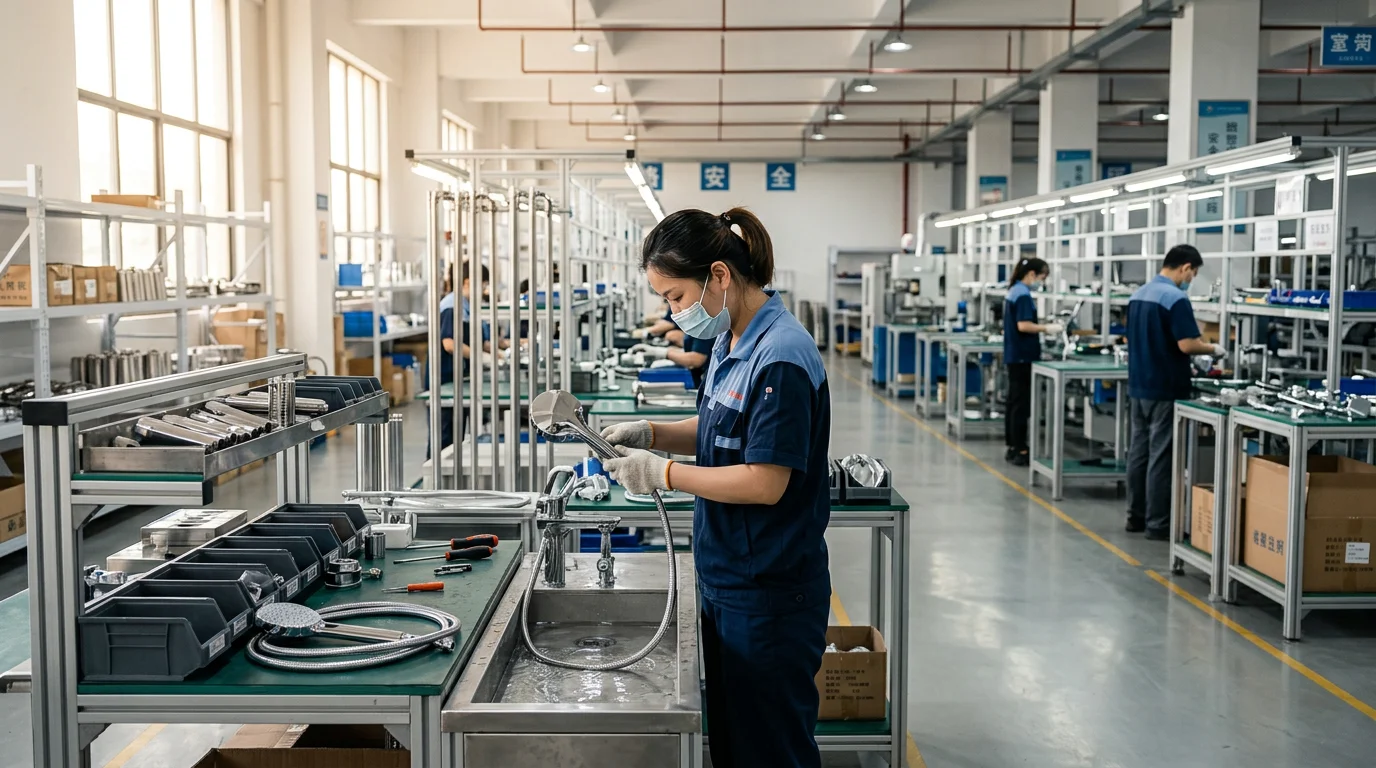
The global shower category is no longer won by generic chrome fixtures and low pricing alone. Retailers, distributors, and DTC bathroom brands now need products that combine distinctive design, reliable engineering, water efficiency, and clear consumer benefits. Partnering with a capable China-based OEM manufacturer can make that possible by connecting custom product development with scalable production economics. This guide explains how to shape a competitive shower line from the ground up, including when to choose OEM instead of ODM or private label, how to set cost and MOQ expectations, and what to look for in a factory partner with R&D, tooling, quality control, and global export experience.
Why Work with a China OEM Shower Manufacturer
Developing a proprietary line of sanitary ware requires a strategic approach to sourcing, manufacturing, and supply chain management. For brands looking to scale, partnering with a China OEM shower manufacturer offers a distinct competitive advantage, merging advanced production capabilities with significant economies of scale. The sanitary ware manufacturing hubs in China, particularly in regions like Kaiping, Nan'an, and Wenzhou, have evolved from basic assembly operations into highly sophisticated engineering centers.
Engaging directly with an Original Equipment Manufacturer (OEM) allows brands to bypass the limitations of standard catalogs, granting total control over product architecture, material selection, and aesthetic finishes. This foundational control is critical for companies seeking to capture premium market segments rather than competing solely on price in the commoditized sanitary fixtures space.
How OEM manufacturing supports brand positioning
Establishing a dominant brand positioning in the plumbing fixtures market necessitates unique product differentiation. When a company relies entirely on off-the-shelf designs, it becomes vulnerable to direct price comparisons with competitors sourcing the exact same models. An OEM manufacturing model directly supports premium brand positioning by enabling exclusive industrial designs, proprietary ergonomic features, and custom colorways.
By investing in custom tooling and proprietary molds, brands can engineer specific tactile experiences—such as the precise rotational resistance of a diverter knob or the specific spray pattern of a showerhead. This level of customization ensures that the final product aligns perfectly with the brand’s visual identity and functional promises, creating a defensible intellectual property portfolio in the process.
OEM vs ODM vs private label
Navigating the terminology of overseas sourcing is critical for setting operational expectations. Original Equipment Manufacturing (OEM) refers to a scenario where the buyer provides the complete design, engineering drawings, and specifications, and the factory simply executes the production. This grants the buyer full ownership of the intellectual property.
Conversely, Original Design Manufacturing (ODM) involves selecting a pre-engineered design owned by the factory and requesting minor modifications, such as customized handles or bespoke finishes. Private labeling, or white-labeling, requires no design input; buyers simply brand an existing off-the-shelf product. While private labeling may only require a Minimum Order Quantity (MOQ) of 50 to 100 units, true OEM partnerships typically demand MOQs ranging from 500 to 1,000 units per SKU to justify the setup and calibration of custom production runs.
Product-line goals to define before sourcing
Before initiating contact with any manufacturing partner, procurement and product teams must establish rigid product-line goals. This begins with defining the target retail price or target ex-factory cost, which directly informs the allowable Bill of Materials (BOM) cost. A common industry benchmark is targeting a 4:1 or 5:1 ratio between the Manufacturer's Suggested Retail Price (MSRP) and the landed cost. However, these targets depend heavily on marketing overhead, channel mix, and brand equity, and they vary drastically depending on whether the distribution model relies on direct-to-consumer (DTC) e-commerce, traditional wholesale, or retail.
Furthermore, buyers must define the intended distribution channels. E-commerce lines prioritize lightweight materials and standardized packaging to reduce volumetric shipping weight, whereas showroom-grade fixtures prioritize heavy-duty brass construction and complex PVD (Physical Vapor Deposition) finishes where tactile weight translates directly to perceived value.
Key Shower Product Specifications to Define
The success of an OEM partnership hinges entirely on the clarity and comprehensiveness of the technical specifications provided to the factory. Ambiguity in a specification sheet inevitably leads to component substitution, quality fade, and inconsistent batch production. To mitigate language barriers and prevent specification drift during engineering handoffs, it is highly recommended to provide bilingual technical drawings or utilize a bilingual technical liaison.
To build a competitive shower product line, engineering teams must document every variable, from the internal waterway architecture to the exact chemical composition of the base metals. A professional manufacturing partner expects detailed CAD models, 2D technical drawings with defined tolerances, and explicit component callouts before agreeing to a manufacturing contract.
Shower product architecture and components
Shower systems are complex assemblies comprising multiple sub-components, each requiring specific manufacturing disciplines. The architecture typically revolves around the rough-in valve, which dictates whether the system is exposed or concealed. Concealed thermostatic valves demand high-precision machining to ensure the hot and cold water mixing chambers maintain strict temperature stability.
Beyond the primary valve, the architecture includes diverters, showerheads, hand showers, slide bars, and Flexible Hoses. Buyers must specify the thread standards—such as NPT (National Pipe Thread) for North America or BSP (British Standard Pipe) for Europe—to ensure seamless installation by end-market plumbers. Failure to define these architectural constraints early in the design phase can result in costly product incompatibility, though thread standard mismatches are generally correctable during design validation.
Materials, finishes, cartridges, and flow rates
Material selection is the primary driver of both unit cost and product longevity. High-quality shower valves are typically forged from brass to ensure structural integrity under high water pressure. However, it is critical to note that standard alloys like CW617N (European standard) or HPb59-1 (Chinese standard) contain lead levels that do not meet NSF/ANSI 372 "lead-free" requirements for North America. For compliant markets, buyers must specify true low-lead or DZR (Dezincification Resistant) alternatives, such as CW602N or C27450. Cheaper alternatives, such as zinc alloys, are highly susceptible to corrosion and should be restricted to non-water-bearing components like handles or escutcheon plates.
The internal cartridge acts as the engine of the shower system. Specifying globally recognized cartridge brands, such as Sedal (Spain) or Vernet (France), guarantees a lifecycle of at least 500,000 operational cycles and ensures precise temperature calibration. Additionally, environmental regulations dictate strict maximum flow rates. For the US market, flow restrictors must be calibrated to a maximum of 1.8 to 2.5 Gallons Per Minute (GPM) to meet WaterSense and state-specific efficiency mandates. Surface finishes also require strict specification, with PVD coatings offering superior scratch resistance compared to traditional electroplated chrome.
Specification comparison table for product tiers
To illustrate how specifications scale across different market positions, the following matrix outlines the typical component and material configurations for entry-level, mid-range, and premium shower systems.
| Specification Category | Entry-Level Tier | Mid-Range Tier | Premium / Architectural Tier |
|---|---|---|---|
| Primary Valve Body | Zinc Alloy or Low-Grade Brass | Standard HPb59-1 Brass | DZR (Dezincification Resistant) Brass |
| Internal Cartridge | Generic Domestic (China) | Sedal or Wanhai (Ceramic) | Vernet (Thermostatic) or Flühs |
| Surface Finish | Standard Chrome Electroplating | Brushed Nickel / Matte Black | PVD (Physical Vapor Deposition) |
| Showerhead Material | ABS Plastic | ABS Plastic with Brass Ball Joint | Solid 304 Stainless Steel or Brass |
| Target Flow Rate | 2.5 GPM (Standard) | 1.8 GPM (WaterSense Compliant) | 1.5 GPM (Ultra-High Efficiency) |
| Expected Lifecycle | 100,000 Cycles | 300,000 Cycles | 500,000+ Cycles |
Providing a specification table similar to this during the initial Request for Quotation (RFQ) process forces the manufacturer to quote accurately against fixed parameters, eliminating the risk of hidden cost-cutting measures.
How to Qualify a China OEM Shower Manufacturer
Identifying a capable OEM partner requires looking beyond polished B2B directory profiles and engaging in rigorous factory vetting. The sanitary ware industry features a complex ecosystem of trading companies, final assembly plants, and vertically integrated manufacturers. Buyers must remain vigilant, as trading companies frequently misrepresent themselves as vertically integrated factories.
To protect capital investments and ensure scalable production, brands must implement a strict qualification framework. This framework should evaluate the supplier’s true engineering depth, their transparency during the quotation phase, and their historical performance in highly regulated export markets.
Factory capabilities and engineering resources
A true OEM partner must possess robust internal engineering resources and modern production infrastructure. During a factory audit, buyers should assess several key capabilities to ensure the facility can meet production demands:
- Machining Infrastructure: The presence and condition of multi-axis CNC machining centers, which are essential for achieving the tight tolerances required in complex valve bodies.
- Casting Methods: Whether the factory utilizes gravity casting, which produces denser, higher-quality brass components, or sand casting. While gravity casting is preferred for primary valves, sand or investment casting remains viable for certain complex valve geometries.
- Surface Finishing Control: While many factories outsource electroplating to specialized environmental zones to comply with local emission laws, the best OEM partners maintain strict in-house quality control over the outsourced plating process.
- R&D and Engineering: The presence of an in-house R&D team capable of translating conceptual CAD files into optimized, mold-ready engineering drawings is a strong indicator of a mature OEM facility.
RFQ requirements, BOM transparency, and tooling
The Request for Quotation (RFQ) phase is a critical test of a supplier's transparency and consolidates the workflow from design to quotation. A qualified supplier will provide an itemized Bill of Materials (BOM) rather than a single, opaque unit price. This BOM should break down the cost of the raw brass, the specific cartridge, the finishing process, and the assembly labor.
Tooling represents a significant upfront capital expenditure in OEM manufacturing. Molds for custom zinc or brass components typically range from $3,000 to $10,000 per mold, depending on the complexity and the number of cavities. Buyers must establish clear ownership terms for these molds via a tooling agreement. Furthermore, the RFQ should establish firm lead times; a standard timeline for custom T1 (first-off) tooling samples is generally 45 to 60 days from the approval of the final 3D drawings.
Equally important during the RFQ phase is establishing commercial realities such as payment terms and Incoterms. Standard OEM engagements often utilize a 30/70 T/T (Telegraphic Transfer) split—a 30% deposit to initiate production and a 70% balance paid before shipment or against the Bill of Lading. Defining Incoterms, such as FOB (Free on Board) or EXW (Ex Works), is essential for accurate cash-flow planning and risk mitigation.
Supplier comparison matrix for factory verification
To systematically evaluate potential manufacturing partners, procurement teams should utilize a standardized comparison matrix. This prevents subjective decision-making and highlights critical operational gaps.
| Qualification Criteria | Trading Company | Standard Assembly Factory | Vertically Integrated OEM |
|---|---|---|---|
| In-House CNC Machining | No | Partial (Often Outsourced) | Yes (Multi-Axis Centers) |
| Custom Tooling Capability | No | Limited to basic modifications | Full custom mold design & ownership |
| BOM Transparency | Low (Markup applied to total) | Medium (Basic component list) | High (Detailed raw material breakdown) |
| Testing Infrastructure | None | Basic pressure testing | Spectrometers, Salt Spray, Cycle Testing |
| Typical MOQ Requirement | 100 - 500 units | 500 units | 1,000+ units per custom SKU |
Selecting a vertically integrated OEM, despite higher initial MOQs, drastically reduces the risk of intellectual property theft and ensures tighter control over the raw materials entering the production line.
Compliance, Quality, and Logistics Control
Transitioning from an approved prototype to mass production introduces significant risk. Even with a highly qualified factory, production drift can occur if stringent quality control and compliance protocols are not enforced.
Sanitary ware is heavily regulated due to its direct connection to municipal water supplies and its potential to cause severe property damage in the event of a failure. Consequently, a comprehensive risk management strategy must encompass regional compliance, multi-stage quality control, and robust logistics planning.
Regional compliance requirements to check
Before authorizing mass production, the product must meet the statutory compliance requirements of the destination market. In North America, shower valves must carry cUPC certification (verifying compliance with ASME A112.18.1/CSA B125.1 standards), while low-flow showerheads require EPA WaterSense certification. Under these standards, valves primarily require NSF/ANSI 372 certification to verify lead-free compliance. NSF/ANSI 61 (evaluating health effects and leaching) is not universally mandated for shower fixtures unless specific local jurisdictions require potable-water certification for those components.
For the European market, CE marking and adherence to EN 1111 (for thermostatic mixing valves) are mandatory. The UK market requires WRAS approval, and Australia demands WaterMark certification. Obtaining these certifications often requires sending production samples to independent third-party laboratories (such as IAPMO or Intertek). Buyers must clearly stipulate in the manufacturing contract whether the OEM or the brand is responsible for the financial cost and timeline of these certification processes.
Quality control for materials, production, and inspection
Quality Control (QC) must be implemented at three distinct stages: Incoming Quality Control (IQC) for raw materials, In-Process Quality Control (IPQC), and Final Quality Control (FQC). IQC should utilize optical emission spectrometers to verify the exact chemical composition of incoming brass ingots, ensuring no high-lead scrap metal is introduced into the supply chain.
During IPQC, standard protocols must dictate 100% air and water leak testing for every single valve body at pressures reaching 1.5 MPa (approximately 15 bar or 217 PSI) to guarantee structural integrity and seal performance. For surface finishes, FQC must include a Neutral Salt Spray (NSS) test lasting a minimum of 24 to 48 hours, or a Copper-Accelerated Acetic Acid-Salt Spray (CASS) test for up to 200 hours, depending on the durability required for the premium tier.
Packaging, logistics, spare parts, and warranty planning
The final stage of manufacturing control involves packaging and logistics. Shower systems are heavy and feature delicate surface finishes that are easily damaged during trans-Pacific transit. E-commerce brands must insist on ISTA 1A or ISTA 3A drop-test certified packaging, utilizing custom-molded EPE foam rather than cheaper EPS (Styrofoam) which crumbles and fails to protect heavy brass valves.
Additionally, a comprehensive warranty program requires a strategic spare parts policy. Brands should negotiate a 1% to 2% spare parts inclusion rate for highly vulnerable or wear-prone components, such as thermostatic cartridges, aerators, and rubber O-rings, included free of charge within the main container shipment. This proactive logistics planning dramatically reduces the domestic cost of fulfilling warranty claims and maintaining customer satisfaction.
When a China OEM Shower Manufacturer Is the Right Choice
Deciding to invest in a proprietary tooling and manufacturing program is a significant strategic commitment. While the operational hurdles are substantial, the financial and competitive rewards of successfully executing an OEM strategy can fundamentally transform a brand's market trajectory.
Understanding when to transition from sourcing white-label products to engaging a China OEM shower manufacturer requires a careful analysis of capital readiness, internal engineering bandwidth, and long-term margin objectives.
Decision framework for cost, control, and risk
The decision to pursue OEM manufacturing relies on a framework balancing upfront cost, operational control, and supply chain risk. Brands must weigh the initial capital expenditure—often requiring $20,000 to $50,000 in custom tooling and certification fees across a complete shower line—against the long-term reduction in unit costs.
By bypassing domestic wholesalers and owning the proprietary design, brands can typically target gross margin improvements of 30% to 50%. However, these projections require explicit caveats: actual realized margins depend heavily on marketing overhead, channel mix, and existing brand equity. This strategy is highly recommended for companies that have already achieved a stable sales volume with off-the-shelf products and are now experiencing margin compression due to price wars. However, if a brand lacks the cash flow to sustain a 6-month development cycle without immediate revenue, an ODM or white-label approach remains the safer interim choice.
Step-by-step launch roadmap
Executing an OEM strategy requires a realistic product launch roadmap spanning 6 to 9 months. Months 1 and 2 are dedicated to industrial design, 3D CAD finalization, and the RFQ process. Months 3 and 4 involve mold creation and the production of T1 (first-off) samples. The brand must then rigorously test these samples in domestic environments.
Months 5 and 6 are generally consumed by design revisions, pilot production runs (typically 50-100 units), and the submission of products for regulatory certifications. It is important to warn that third-party certifications (such as cUPC, WaterMark, or WRAS) often require 3 to 6 months to process. This can easily extend the standard 6-to-9-month timeline, rather than fitting neatly within months 5 and 6. Finally, Months 7 through 9 (or later, pending certification) encompass the first full mass production run, final factory quality inspections, and the 30-to-40-day ocean freight transit. Attempting to artificially compress this timeline inevitably results in skipped QC steps and defective initial batches.
Practical conditions for a successful OEM partnership
A successful partnership with an overseas supplier extends far beyond the first Purchase Order. It requires establishing a sustained vendor management program characterized by continuous improvement and clear communication. Buyers must attempt to protect their investments by executing robust NNN (Non-Disclosure, Non-Use, Non-Circumvention) agreements before sharing any proprietary CAD files. However, it is crucial to acknowledge the practical difficulties of enforcing foreign contracts in Chinese courts; an NNN serves more as a deterrent and a filter for trustworthy partners than an ironclad legal shield. Therefore, NNN agreements must be supplemented with practical, non-legal IP protection measures. These include maintaining mold ownership in escrow and avoiding sharing complete CAD assemblies until late-stage vetting is complete.
Furthermore, successful brands treat their OEM factories as strategic extensions of their own business. Conducting annual or bi-annual factory visits, sharing end-consumer feedback directly with the factory's engineering team, and collaboratively forecasting production volumes ensures that the manufacturer remains invested in the brand's long-term growth and prioritization during peak manufacturing seasons.
Key Takeaways
- Define your target MSRP, landed cost, and BOM limit before sourcing so the manufacturer can engineer the shower line around realistic margin requirements.
- Choose OEM when you need exclusive product architecture, proprietary features, custom finishes, or stronger control over intellectual property.
- Use ODM or private label for faster launches, but expect less differentiation than a true OEM shower product line.
- Plan for higher OEM MOQs, commonly around 500 to 1,000 units per SKU, because custom tooling and production setup require scale.
- Prioritize manufacturers with full-chain production, R&D support, and experience in high-pressure, water-saving, filtration, and multi-function shower products.
- Build product differentiation around tangible user benefits such as spray performance, ergonomic controls, water efficiency, filtration, and finish quality.
Frequently Asked Questions
What is the main advantage of working with a China OEM shower manufacturer?
OEM manufacturing gives brands more control over design, materials, finishes, spray functions, and cost structure, helping them build differentiated shower products instead of competing only on price.
How is OEM different from ODM and private label shower sourcing?
OEM uses your own specifications and designs, ODM adapts a factory-owned design, and private label simply adds your branding to an existing product with minimal customization.
What MOQ should buyers expect for OEM shower products?
Private label orders may start around 50 to 100 units, while true OEM projects often require 500 to 1,000 units per SKU because custom setup, tooling, and calibration are involved.
Which shower products can XinYi Sanitary Wares manufacture?
XinYi manufactures hand showers, Rainfall Shower Heads, shower sets, bidet showers, sliding bars, filters, and bathroom hardware, with options for water saving, high pressure, filtration, and multi-function sprays.
Why should brands define price targets before contacting a factory?
Target MSRP, landed cost, and BOM limits guide material choices, feature selection, packaging, and production feasibility, preventing over-engineered products that cannot meet channel margins.
