


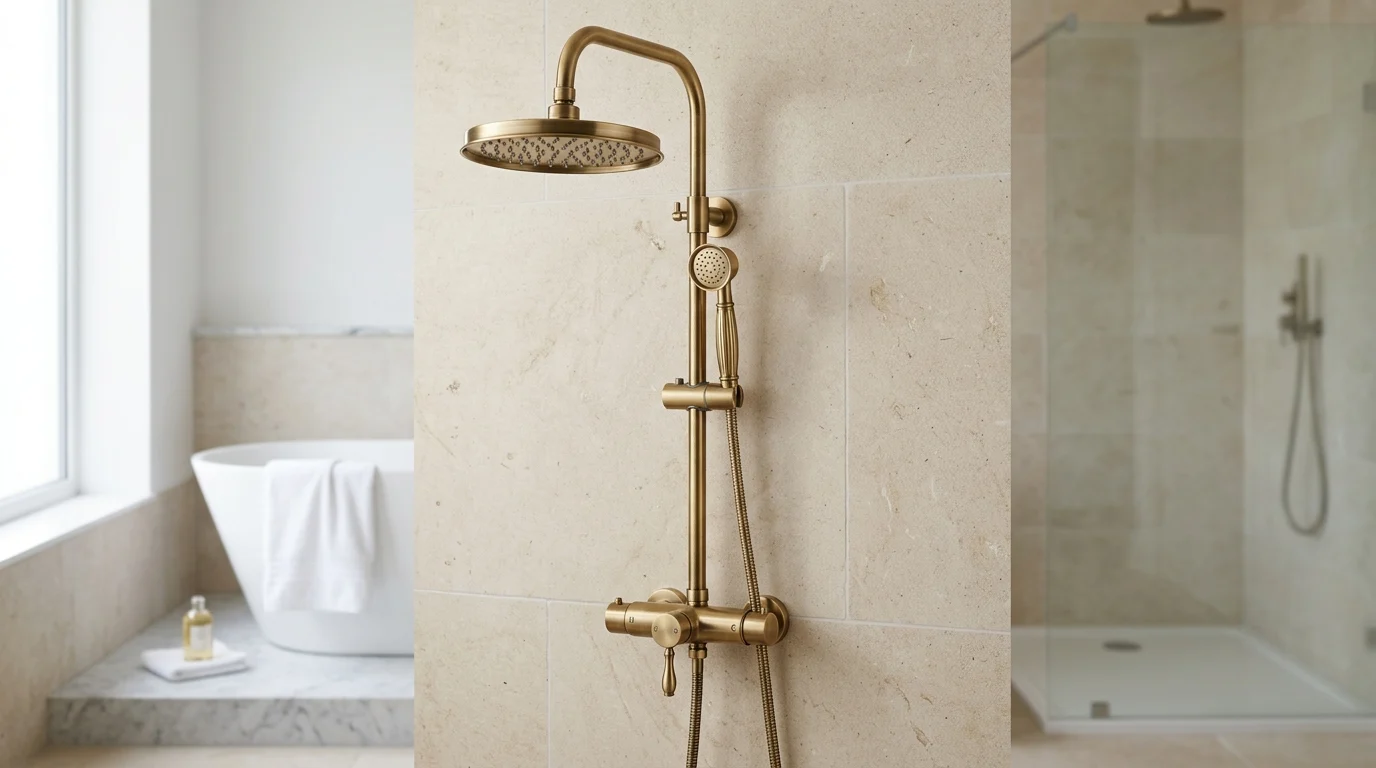
A rain shower system works harder than it looks: every day, its valves, arms, threads, and Shower Head face temperature swings, pressure spikes, mineral buildup, and constant moisture. For buyers comparing bathroom upgrades or sourcing shower products at scale, material choice directly affects service life, leak risk, and maintenance cost.Brass remains one of the most dependable choicesbecause it combines structural strength, corrosion resistance, and stable machining performance. This article examines the brass grades, wall thicknesses, manufacturing methods, and water-condition factors that determine whether a rain Shower Set performs reliably for years—or fails early under daily use.
Why Brass Rain Shower Sets Last Longer
Choosing a solid brass rain shower set is one of the most reliable ways to avoid early failure in both residential and commercial bathrooms. While alternative materials offer upfront cost savings, brass provides excellent structural integrity and resistance to the corrosive forces inherent in water delivery systems. By resisting thermal fatigue and maintaining structural density under pressure, brass avoids the rapid degradation commonly seen in cheaper alloys.
Operating Conditions That Stress Shower Sets
Shower sets operate in highly dynamic environments. Daily usage introduces severe thermal shock, with water temperatures rapidly fluctuating between 10°C and 60°C. Furthermore, static and dynamic water pressure spikes—sometimes peaking at 1.0 MPa (145 PSI) in multi-story buildings—place immense mechanical stress on joints and concealed valve bodies.
Hard water environments exacerbate these issues. Calcium and magnesium deposits accelerate internal scaling, which restricts flow and increases internal hydrostatic pressure. It is also important to note the impact of local water chemistry; even when utilizing Dezincification Resistant (DZR) brass, aggressive conditions such as highly chlorinated or low-pH water can still induce corrosion over time. Additionally, unplated brass components can develop a natural patina or verdigris, requiring regular cleaning to maintain their appearance. Homeowners in areas with extreme water chemistry should consider regular water testing or installing softening systems to protect their plumbing investments.
Brass Grade, Wall Thickness, and Machining Quality
The longevity of a brass rain shower set relies heavily on the specific alloy grade and manufacturing tolerances. Premium sets utilize high-grade brass such as CW617N or HPb59-1, which offer excellent machinability and robust resistance to dezincification—a process where zinc leaches from the alloy, leaving behind a porous and brittle copper shell.
To prevent burst failures under high pressure, valve bodies and threaded connections must maintain a minimum wall thickness of 2.5mm to 3.0mm. Precision CNC machining ensures that these critical dimensional tolerances are consistently met. This high-tolerance machining minimizes micro-fissures and internal porosity that frequently compromise cheaper, sand-cast shower components, ensuring a leak-free lifespan even under continuous mechanical stress.
Key Components That Need Tight Specifications
A complete rain shower system is an assembly of interconnected parts, meaning the failure of a single concealed valve or exposed arm compromises the entire installation. Buyers must look for tight engineering specifications across the mixer body, shower head, and mounting hardware to guarantee holistic system reliability and safety.
Rain Shower Heads, Arms, and Mixer Bodies
The mixer body acts as the central command center for temperature and flow regulation. Gravity-forged brass mixer bodies are heavily preferred over cast alternatives due to their superior material density and lack of internal voids. This density is crucial for maintaining pressure integrity over decades of use. High-quality mixer bodies must also integrate thermostatic or pressure-balancing valves to provide essential anti-scald protection.
Rain Shower Arms, which must sustain the cantilevered weight of largeshower heads (often weighing between 2.0kg and 5.0kg for 12-inch to 16-inch models), require high tensile strength to resist bending moments and thread shear. Because solid brass arms and heads are significantly heavier than plastic alternatives, they require robust in-wall structural support during installation to prevent sagging or pipe damage. The shower heads themselves benefit immensely from brass construction to prevent the seam splitting commonly observed in ultrasonic-welded plastic heads, though buyers should also ensure selections meet local low-flow and water-saving regulations (such as EPA WaterSense). Finally, buyers should remain vigilant, as "solid brass" marketing claims occasionally conceal brass-plated zinc cores—a shortcut that severely compromises longevity.
Material, Coating, and Performance Comparison
Comparing brass to alternative materials highlights its operational superiority in load-bearing and high-pressure applications.
| Material | Typical Tensile Strength | Expected Valve Lifespan (Actuation Cycles) | Corrosion Resistance | Max Operating Temp |
|---|---|---|---|---|
| Solid Brass (CW617N) | ~400 MPa | 500,000+ | Excellent (DZR options available) | 90°C+ |
| Zinc Alloy (Zamak 3) | ~280 MPa | 100,000 - 150,000 | Poor (Prone to pitting) | 60°C |
| ABS Plastic | ~40 MPa | 50,000 - 100,000 | High (Prone to thermal fatigue) | 60°C |
Engineers and specifiers choose solid brass for components subjected to continuous hydrostatic pressure and mechanical load. ABS plastic or stainless steel are generally reserved for non-load-bearing trim plates or decorative faceplates where weight reduction is necessary and structural integrity is not the primary concern.
Finishes, Cartridges, Seals, and Flow Control
Beyond the raw structural material, a shower set's functional lifespan relies on its surface treatments, internal valving, and sealing mechanisms. Multi-layer plating protects the exterior from corrosion, while precision ceramic cartridges and elastomeric seals ensure leak-free daily operation.
Plating Systems and Surface Treatments
Surface degradation is a leading cause of fixture replacement. High-quality brass shower sets employ multi-layer electroplating systems to achieve a durable, non-porous finish. A standard specification requires an underlying nickel layer of 8.0 to 12.0 µm for superior corrosion resistance, topped with a chromium layer of 0.2 to 0.3 µm for surface hardness and aesthetic brilliance.
To validate these coatings, components are subjected to rigorous environmental testing. Premium finishes are typically benchmarked to pass an Acid Salt Spray (ASS) test for 24 to 48 hours, or a Neutral Salt Spray (NSS) test for upwards of 200 hours without showing signs of blistering or delamination. Advanced Physical Vapor Deposition (PVD) finishes offer even greater scratch resistance for colored fixtures, with manufacturers often reporting Vickers hardness values reaching up to 2000 HV. However, buyers should note that PVD and specialty colored finishes can cost significantly more than standard chrome, requiring a balanced cost-benefit analysis.
Ceramic Cartridges, Seal Compounds, and Nozzles
Flow and temperature control rely entirely on the precision of ceramic disc cartridges. Industry benchmarks suggest that premium cartridge models are designed to endure hundreds of thousands of actuation cycles without failure. The integrity of these cartridges, as well as the broader mixer body, depends heavily on high-grade elastomeric seals.
Ethylene Propylene Diene Monomer (EPDM) or Fluoroelastomer (FKM) O-rings are specified for their ability to withstand constant exposure to chloramines and continuous water temperatures up to 90°C. At the shower head interface, Liquid Silicone Rubber (LSR) nozzles are integrated. To maximize this lifespan in daily use, homeowners and facility managers should adopt a regular maintenance cadence: descaling nozzles quarterly with a simple swipe to prevent back-pressure issues, inspecting elastomeric seals annually, and planning for cartridge replacements every 7 to 10 years depending on local water hardness.
Sourcing, Compliance, and Quality Checks
Global supply chains for plumbing fixtures are heavily regulated to protect public health and safety. Buyers and specifiers must navigate a complex matrix of material compliance standards and look for manufacturers that implement robust quality assurance protocols to ensure long-term reliability.
Brass Alloy Standards and Regional Requirements
Regulatory frameworks governing potable and bathing water systems dictate the permissible chemical composition of brass alloys. North American markets mandate strict lead-free compliance, heavily influencing raw material sourcing at the foundry level.
| Region/Market | Regulatory Standard | Max Permissible Lead (Pb) / Leaching | Preferred Brass Alloy |
|---|---|---|---|
| United States (CA) | AB1953 / NSF 61 | < 0.25% weighted average | Lead-Free Brass (e.g., C69300 or C87850) |
| European Union | DWD (Drinking Water Directive) | 10 µg/L leaching limit (4MS schemes) | CW511L or CW724R (DZR) |
| Australia | WaterMark (AS/NZS 3718) | < 0.25% (check local guidelines for updates) | DR Brass (Dezincification Resistant) |
Diligent buyers or their suppliers should verify material test reports (MTRs) and optical emission spectrometry (OES) results to ensure the brass ingots strictly comply with the destination market's specific lead, arsenic, and bismuth thresholds.
Factory Audits, Inspections, and Pressure Tests
Rigorous factory testing separates premium manufacturers from commodity suppliers. Reputable brands mandate 100% pneumatic testing of all concealed mixer bodies at 0.6 MPa (87 PSI) to detect micro-porosity and verify seal integrity before final assembly.
Additionally, statistical batch sampling must include destructive hydraulic burst testing at 2.5 MPa (360 PSI) to validate the structural limits of the brass castings. Comprehensive factory audits also evaluate the calibration of CNC machinery and the chemical consistency of electroplating baths, aiming to keep the final functional defect rate as low as possible.
How Buyers Should Choose a Long-Life Set
Selecting a high-performance brass rain shower set requires a strategic approach that evaluates total cost of ownership (TCO) rather than focusing solely on the initial unit price. Buyers must align product specifications with long-term maintenance realities and part availability.
Balancing Cost, Repairability, and Spare Parts
While solid brass components carry an estimated 30% to 40% cost premium over zinc or plastic hybrid alternatives, this upfront capital investment yields significant downstream savings. In commercial and high-use residential applications, specifying solid brass structural components can significantly reduce replacement rates over a 10-year lifecycle.
Furthermore, buyers should prioritize shower sets that utilize standardized, non-proprietary internal components. Specifying systems with standard 35mm or 40mm ceramic cartridges ensures that homeowners or facilities management teams can easily and cost-effectively source spare parts globally. This eliminates the costly need to open up drywall to replace an entire concealed mixer body simply due to a proprietary seal failure.
Approval Process for Final Product Selection
For large-scale renovations or custom builds, buyers should put final selections through a structured review. This begins with the evaluation of a physical sample, which is checked for flow rate consistency, low acoustic noise during operation, and finish durability.
Inspection reports should confirm that dimensional tolerances perfectly align with the approved specifications. When sourcing directly from manufacturers for multi-unit projects, buyers should note that factory orders may require minimum order quantities (MOQs), while custom PVD finishes frequently require higher volumes to justify setup costs.
Ultimately, ensuring a shower set lasts longer in daily use comes down to verifying core specifications. By prioritizing engineering criteria over superficial aesthetics, buyers guarantee a fixture that withstands the rigors of daily operation. Use this checklist when making a final selection:
- Alloy Grade: Confirm lead-free or DZR brass compliance based on local regulations.
- Wall Thickness: Ensure adequate thickness (typically 2.5mm to 3.0mm) for pressure-bearing valve bodies.
- Cartridge Standard: Verify the use of standard 35mm or 40mm ceramic cartridges for easy replacement.
- Plating Reports: Demand ASS/NSS testing validation for chrome or PVD finishes.
- Spare Parts: Check the long-term availability of elastomeric seals and replacement cartridges.
By verifying these structural and material details rather than relying on aesthetics alone, you can secure a rain shower system built for true longevity.
Key Takeaways
- Choose solid brass rain shower set components when daily use, thermal shock, and pressure fluctuations make long-term durability a priority.
- Specify high-grade brass such as CW617N or HPb59-1 to improve machinability and resistance to dezincification.
- Look for valve bodies and threaded connections with 2.5mm to 3.0mm wall thickness to reduce burst and leakage risks.
- Use precision-machined components instead of low-grade cast parts to minimize internal porosity, micro-fissures, and premature failure.
- Test aggressive or hard water conditions and consider filtration or softening to reduce scaling, corrosion, and pressure stress inside the shower system.
Frequently Asked Questions
Why is brass preferred for rain shower sets?
Solid brass offers strong pressure resistance, stable performance under hot and cold water changes, and better corrosion resistance than many lower-cost alloys or plastics.
What brass grades are suitable for long-lasting shower components?
Common high-quality options include CW617N and HPb59-1, which provide good machinability and improved resistance to dezincification in demanding water conditions.
How thick should brass shower valve bodies and threaded parts be?
For reliable daily use, critical brass parts such as valve bodies and threaded connections should typically maintain a wall thickness of about 2.5mm to 3.0mm.
Can hard water shorten the life of a brass rain shower set?
Yes. Calcium and magnesium scale can restrict flow, raise internal pressure, and increase wear. Water softening or regular maintenance helps protect the system.
Are forged brass mixer bodies better than cast ones?
Forged brass mixer bodies are generally preferred because they have higher material density and fewer internal voids, improving pressure integrity and long-term reliability.
