


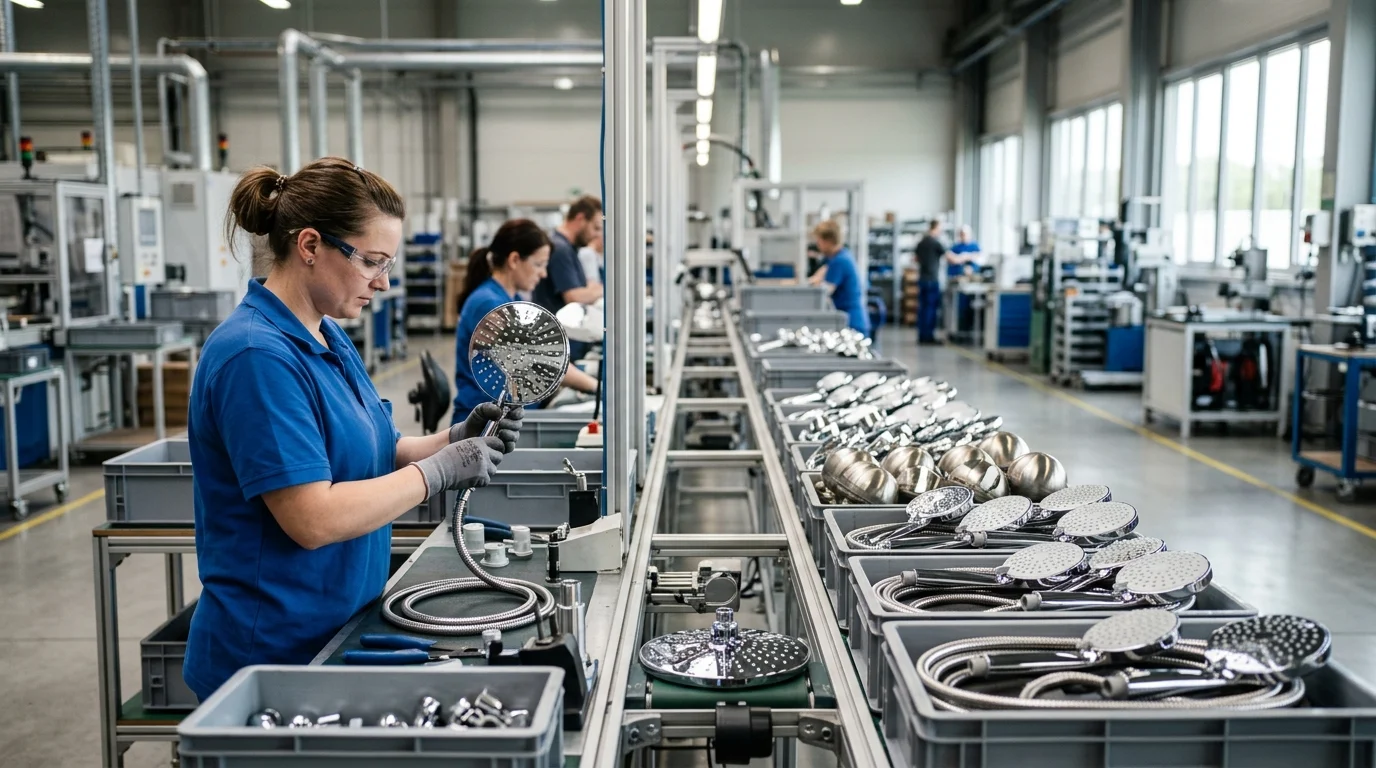
A Shower Head may look simple, but the factory behind it determines far more than the purchase price. For importers, distributors, and private-label brands, supplier selection affects defect rates, finish durability, tooling investment, compliance exposure, and launch speed. A quote that appears 10% cheaper can become expensive if plating fails, components vary, or shipments miss the sales window. This guide breaks down the practical questions buyers should ask before committing to a manufacturing partner, fromOEM versus ODM tooling to salt spray testing, patent ownership, supplier controls, and product engineering. The goal is to help procurement teams qualify factories with evidence—not assumptions.
Why Factory Selection Shapes Shower Head Cost
Procuring sanitary ware requires a rigorous supplier qualification process. The choice of a shower head factory fundamentally dictates not only the baseline unit economics but also the long-term viability of the product line. Buyers must navigate a complex landscape of manufacturing variables, where initial cost savings of 10% to 15% can quickly be erased by elevated defect rates exceeding 3% to 5%, delayed shipments, or non-compliance with regional plumbing codes.
Understanding the structural differences between potential manufacturing partners allows procurement teams to align their supply chain strategy with their capital constraints and go-to-market timelines. To bridge the gap between technical specifications and supplier accountability, buyers structure their vetting process around nine critical questions commonly asked during strategic factory qualification.
Key Risks to Assess Before Shortlisting
Question 1: What are your environmental testing protocols for surface finishes?
Inadequate vetting exposes buyers to severe operational and financial liabilities. A primary risk is inconsistent surface finishing, which often manifests as peeling or corrosion after minimal use. Factories must demonstrate the ability to pass stringent environmental testing. While specific requirements vary by market tier, an illustrative target is the 24-hour to 48-hour Acid Salt Spray (ASS) test, which ensures chrome or physical vapor deposition (PVD) finishes withstand humid bathroom environments without blistering or pitting.
Another critical risk involves intellectual property (IP) leakage and sub-tier supplier instability. Shower head assembly relies on multiple components, including internal cartridges, rubber nozzles, and flow restrictors. If the primary factory lacks control over its sub-tier suppliers, buyers face unpredictable variances in raw material quality and unannounced component substitutions that can compromise the entire batch.
How to Define OEM and ODM Factory Fit
Question 2: Do you own the design patents, or are we funding custom tooling?
Differentiating between Original Equipment Manufacturer (OEM) and Original Design Manufacturer (ODM) partners is critical for capital allocation. OEM partnerships require the buyer to fund and own the injection molds and tooling. While this offers complete control over the proprietary design, it requires higher upfront capital. Plastic injection molds for a custom shower head typically range from $3,000 to $12,000 per set in Asian manufacturing hubs, depending on complexity and the number of mold cavities, with tooling lead times averaging 30 to 45 days.
Conversely, ODM factories provide off-the-shelf designs that can be branded or slightly modified with custom finishes. This route eliminates heavy tooling investments and accelerates time-to-market. However, buyers must confirm whether the ODM holds the necessary design patents to prevent future infringement claims, and ensure that the factory's existing tooling is maintained to a standard that prevents flashing or dimensional inaccuracies in the molded ABS components.
Section Takeaways:
- Ask about ASS testing to prevent finish corrosion and verify sub-tier supplier controls.
- Clarify OEM vs. ODM pathways to determine tooling ownership and IP protection.
- Budget appropriately for mold investments, noting that costs vary by region and cavity count.
Product and Engineering Questions to Ask
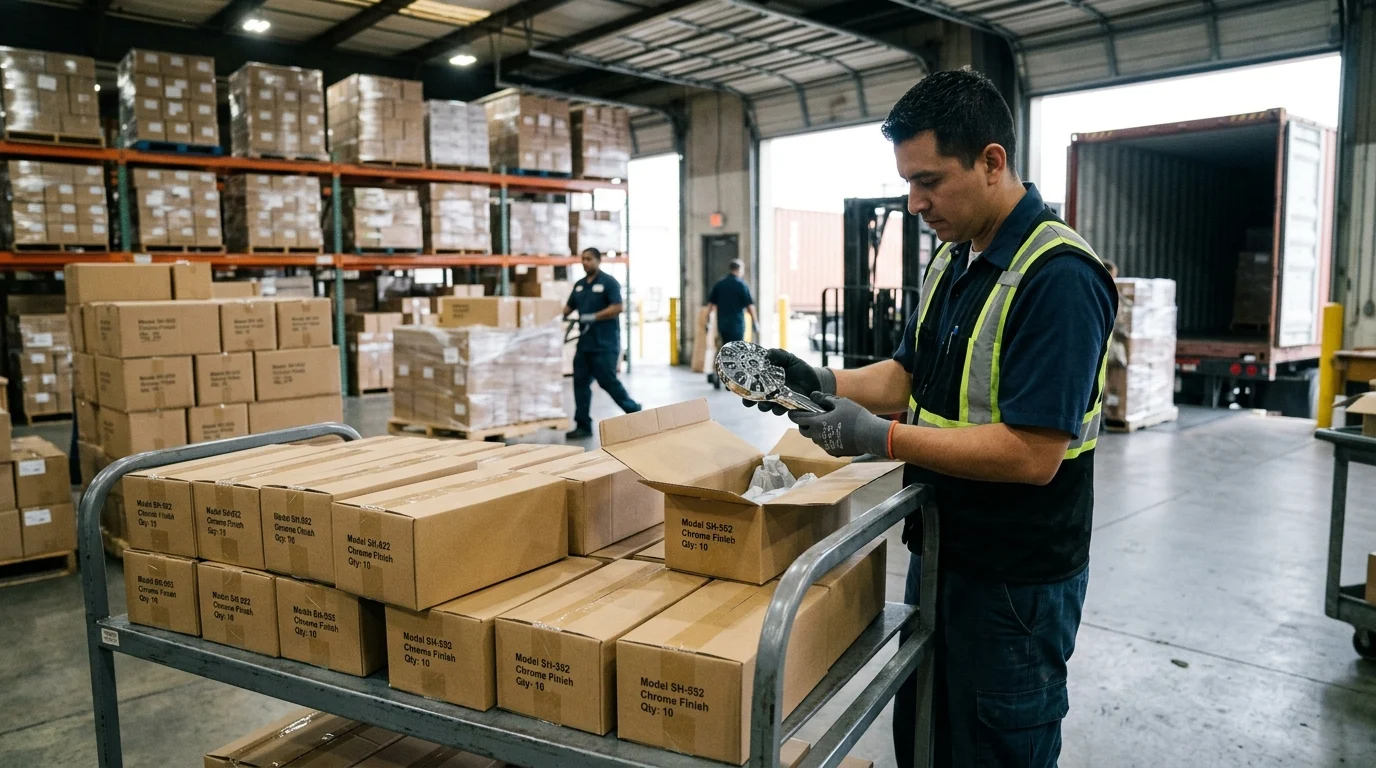
Engineering competence directly dictates the functional lifespan and regulatory compliance of the final shower head assembly. Procurement teams must interrogate the factory's technical capabilities, focusing on internal fluid dynamics, material science, and the rigor of their validation testing.
Can the Factory Meet Required Flow Rates?
Question 3: How do you engineer flow restrictors to meet specific GPM mandates?
Regulatory compliance necessitates precise control over water consumption without sacrificing user experience. In the North American market, standard shower heads operate at 2.5 Gallons Per Minute (GPM) at 80 PSI. However, regions adhering to stricter conservation mandates, such as the federal EPA WaterSense program, require flow rates to be capped at a maximum of 2.0 GPM. Furthermore, state-level regulations like California Title 20 enforce even stricter limits of 1.8 GPM or lower.
Buyers must ask potential factories how they engineer their flow restrictors and aerators to maintain adequate spray pressure at these reduced flow rates. The factory should possess in-house flow testing rigs to verify that every production batch consistently meets the specified GPM tolerance limits (typically ±10% variance), preventing costly compliance failures at customs or point of sale.
How Strong Are Tooling and Material Capabilities?
Question 4: What is the guaranteed shot life of your molds and your tooling maintenance schedule?
Material selection fundamentally impacts both structural integrity and aesthetic longevity. Most Modern Shower Heads utilize Acrylonitrile Butadiene Styrene (ABS) for the main body due to its lightweight nature and thermal resistance. However, the grade of ABS dictates its ability to accept and retain electroplating. Factories must specify the thickness of their plating layers; while buyer specifications vary significantly based on price point, a common high-quality threshold typically demands 8 to 10 micrometers (μm) of Nickel and 0.2 to 0.3 μm of Chrome.
| Material | Typical Application | Relative Cost | Key Engineering Advantage |
|---|---|---|---|
| Virgin ABS | Main body, faceplates | Low-Medium | Excellent moldability, accepts electroplating well |
| Solid Brass | Premium shower heads, ball joints | High | Maximum durability, superior resistance to thermal shock |
| 304 Stainless Steel | Ultra-thin showerheads, rain heads | Medium-High | High corrosion resistance, structural rigidity without bulk |
Understanding the factory's tooling maintenance schedule is equally critical. Molds degrade over time, leading to micro-fissures or parting line mismatches in the molded components. Buyers should request the guaranteed shot life of the molds (typically 300,000 to 500,000 cycles for standard P20 steel) and the factory's protocol for tooling refurbishment.
What Leak-Resistance Test Data Is Available?
Question 5: Can you provide documented leak-resistance test data for extreme hydrostatic pressures?
Static and dynamic pressure testing protocols are non-negotiable for sanitary ware. Shower heads are subjected to constant thermal cycling (often tested between 4°C and 70°C) and water hammer effects. Factories must provide documented leak-resistance test data demonstrating that their assemblies can withstand extreme hydrostatic pressures.
As an illustrative target, a standard quality control protocol requires the shower head to be subjected to internal water pressures ranging from 0.5 MPa to 1.5 MPa (approximately 72 to 217 PSI) for a sustained duration of 3 to 5 minutes without showing signs of leakage, deformation, or structural failure at the seams or the ball joint connection. Absence of this testing data indicates a severe gap in the factory's engineering validation process.
Section Takeaways:
- Verify in-house flow testing capabilities to ensure compliance with federal and regional GPM limits.
- Request specific plating thicknesses and mold maintenance schedules to guarantee longevity.
- Demand hydrostatic pressure test data to prevent catastrophic leaks in the field.
How to Verify Quality Systems and Certifications
A factory's assertion of quality is only as reliable as its documented management systems and third-party validation. Evaluating a manufacturer's adherence to international quality frameworks ensures that production remains consistent across multiple purchase orders and scalable volumes.
Which Market Standards and Certifications Matter?
Question 6: Which specific market standards and certifications do you actively maintain?
Global sanitary ware markets are highly regulated, and importing non-compliant products carries significant legal and financial risk. Buyers must verify that the factory holds the specific certifications required for the target market.
| Target Market | Required Certification | Primary Compliance Focus |
|---|---|---|
| North America | cUPC / ASSE 1014 | Mechanical safety, backflow prevention, threading |
| North America (Eco) | EPA WaterSense / Title 20 | Flow rate efficiency (≤ 2.0 GPM) |
| Europe | CE / EN 1112 | Dimensional standards, acoustic performance |
| UK / France | WRAS / ACS | Material safety for potable water contact |
Furthermore, if the shower head includes brass components, such as the swivel ball joint, the factory must demonstrate compliance with lead-free legislation. Standards like California AB1953 require the weighted average lead content across the wetted surfaces to be less than 0.25%. Buyers should request recent metallurgical test reports from accredited third-party laboratories, rather than relying solely on the factory's internal claims.
Beyond product-specific approvals, modern supplier qualification demands rigorous Environmental, Social, and Governance (ESG) vetting. Buyers should ask about ethical compliance, labor audits, and environmental management systems like ISO 14001 or conflict-mineral policies, as these are now standard pillars of factory qualification alongside quality and price.
How to Audit Materials and Process Controls
Question 7: What are your standard operating procedures for IQC, IPQC, and OQC?
Effective quality control extends beyond final inspection; it must be embedded throughout the manufacturing lifecycle. Buyers should audit the factory's Incoming Quality Control (IQC) to see how they inspect raw ABS pellets and brass ingots. In-Process Quality Control (IPQC) should monitor injection molding temperatures and plating bath chemical balances in real-time.
For Outgoing Quality Control (OQC), buyers must agree upon the Acceptable Quality Limit (AQL) prior to production. A standard industry benchmark for shower heads is an AQL of 1.5 for major defects (such as leaks or severe plating blisters) and 4.0 for minor defects (such as slight surface scratches), targeting a total field failure rate of under 1%. Requesting the factory's standard operating procedures (SOPs) for handling batches that fail these AQL thresholds provides insight into their commitment to continuous improvement.
Section Takeaways:
- Confirm third-party certifications (cUPC, CE, WRAS) relevant to your target market.
- Require independent metallurgical test reports to verify lead-free compliance and audit ESG policies.
- Establish clear AQL thresholds and audit the factory's IQC, IPQC, and OQC processes.
Commercial and Supply Chain Evaluation
Optimizing the procurement strategy requires balancing unit costs against inventory holding costs and supply chain resilience. Commercial negotiations must look beyond the initial quotation to uncover the true landed cost of the shower head inventory.
How to Compare MOQ, Unit Price, and Tooling Cost
Question 8: How do your MOQs and unit prices scale, and can you provide an itemized BOM?
Minimum Order Quantities (MOQs) serve as a critical filter during supplier selection. For standard ODM shower heads, factories in major Asian manufacturing hubs typically enforce MOQs ranging from 500 to 1,000 units per Stock Keeping Unit (SKU) to justify production setups. Custom OEM designs may require MOQs exceeding 2,000 units to offset the operational downtime during line changeovers.
When comparing unit prices, buyers must isolate the cost of raw materials from manufacturing overhead and tooling amortization to avoid redundant charges. A factory offering a unit price that is 15% below the market average is often utilizing recycled ABS regrind rather than virgin resin. Buyers must demand an itemized Bill of Materials (BOM) cost breakdown to ensure price competitiveness is not achieved through material degradation. Furthermore, to calculate the true landed cost, procurement teams must clarify the Incoterms (e.g., FOB vs. EXW), logistics fees, and import-duty implications, as ocean freight and customs duties can easily add 15% to 25% to the baseline FOB price.
Can the Factory Support Stable Lead Times?
Question 9: What are your warranty terms, defect handling procedures, and peak-season lead times?
Production lead times are susceptible to raw material shortages, environmental regulations, and cyclical demand spikes. A capable factory should offer stable, predictable production schedules. Standard lead times for shower head mass production typically range from 35 to 45 days in Asian hubs after the approval of the pre-production sample.
However, buyers must ask how the factory manages capacity during peak seasons or preceding major holidays, where lead times can easily stretch to 65 days or more. Assessing the factory's inventory of critical sub-components will reveal their ability to buffer against upstream supply chain shocks. Furthermore, buyers routinely vet trust and accountability by asking for factory references, clear warranty terms (typically 1 to 3 years for residential, up to 5 years for commercial grade), and explicit defect handling policies to ensure post-sales support is guaranteed.
Section Takeaways:
- Demand an itemized BOM to ensure low unit prices aren't masking inferior materials.
- Clarify Incoterms, logistics, and duties to uncover the true landed cost.
How to Make the Final Factory Selection
Transitioning from initial negotiations to finalizing a partnership with a shower head factory requires a systematic approach. Buyers must shift from evaluating marketing claims to verifying operational data, ensuring the supplier can scale production without compromising engineering tolerances.
Steps From Supplier Screening to Approval
A rigorous vetting process mitigates supply chain risks and ensures regulatory compliance across different target markets. Procurement teams typically follow a four-stage approval pipeline:
- Document Verification: Validate compliance certificates directly with issuing bodies. Look for ISO 9001 for quality management, EPA WaterSense for US market efficiency, or WRAS for UK plumbing standards.
- Engineering and Sample Evaluation: Request pre-production samples to conduct destructive and non-destructive testing. Expert buyers prioritize the 24-hour Acid Salt Spray (ASS) test to verify chrome plating durability, alongside flow rate testing at varying water pressures (e.g., 0.1 to 0.5 MPa).
- Facility Audit: Commission a recognized third-party inspection agency, such as SGS or TÜV Rheinland, to conduct a comprehensive on-site audit. Focus areas should include raw material staging, CNC machining precision, and injection molding defect rates.
- Pilot Production Run: Before committing to high-volume contracts, execute a trial order. This tests the factory's adherence to lead times, packaging specifications, and end-of-line quality control consistency.
Decision Matrix for Comparing Factory Capability
When choosing between shortlisted candidates, a weighted decision matrix provides an objective framework. By assigning numerical values to critical performance indicators, buyers can mathematically determine the most capable shower head factory.
| Evaluation Criteria | Weight (%) | Factory A (1-5) | Factory B (1-5) | Key Indicators |
|---|---|---|---|---|
| Quality Control | 30% | 4 | 5 | In-house testing labs, defect rates, SPC implementation |
| Certifications | 25% | 5 | 3 | WRAS, CE, WaterSense, cUPC validity |
| Production Capacity | 20% | 4 | 4 | Monthly output, automated assembly lines |
| R&D & Tooling | 15% | 3 | 5 | CAD design capabilities, mold-making speed |
| Financial Stability | 10% | 4 | 4 | Payment terms, registered capital, credit reports |
Using this matrix prevents over-reliance on unit price. A shower head factory offering the lowest cost but lacking robust in-house testing or valid international certifications often introduces downstream liabilities, such as customs rejections, product recalls, or elevated warranty claims.
Key Takeaways
- Do not choose a factory on price alone, because 10% to 15% upfront savings can be lost if defect rates exceed 3% to 5% or shipments are delayed.
- Request documented 24- to 48-hour Acid Salt Spray testing for chrome or PVD finishes to reduce corrosion, peeling, and surface-finish claims.
- Clarify whether the project is OEM or ODM before ordering, since custom shower head molds may cost $3,000 to $12,000 and take 30 to 45 days.
- Verify design-patent ownership and tooling condition when using ODM products to avoid infringement risks and dimensional defects.
- Audit sub-tier supplier controls for cartridges, rubber nozzles, flow restrictors, and filters to prevent unapproved component substitutions.
- Prioritize factories with full-chain production, R&D capability, and export experience when sourcing water-saving, filtration, and multi-function shower products.
Frequently Asked Questions
What should buyers check first when evaluating a shower head factory?
Start with quality controls, finish testing, compliance experience, and supplier stability. A low unit price is risky if defect rates, corrosion, shipment delays, or unverified components increase total landed cost.
Why is acid salt spray testing important for shower heads?
ASS testing helps verify that chrome, PVD, or plated finishes can resist humid bathroom environments. Buyers often look for 24- to 48-hour test capability to reduce peeling, blistering, and corrosion complaints.
What is the difference between OEM and ODM shower head manufacturing?
OEM usually means the buyer funds and owns custom tooling for a proprietary design. ODM uses the factory’s existing designs, which lowers upfront cost and speeds launch but requires patent and tooling-condition checks.
How much can custom shower head tooling cost?
Plastic injection molds for custom shower heads can range from about $3,000 to $12,000 per set, depending on design complexity, mold cavities, and production region. Typical tooling lead time is 30 to 45 days.
How can buyers reduce IP and component quality risks?
Ask whether the factory owns design patents, controls sub-tier suppliers, and documents approved materials for cartridges, nozzles, flow restrictors, and filters. This helps prevent substitutions and infringement disputes.